
REVIEW: Urushi Now - Contemporary Japanese Lacquer at the V&A Museum, London
written by Alex Whittaker, June 2026
Urushi Now: Contemporary Japanese Lacquer at the V&A London is a survey of decorative, functional objects and contemporary sculpture, all made within the lacquerware tradition of Japan. The show includes various historical examples which help to inform and contextualize the more recent works, yet the focus here is on living, breathing artists; craftspeople who are continuing to transmit the ancient craft of lacquerware production and project it into a new future. The exhibition has been curated by Dr. Masami Yamada from the Asia Department at the V&A and runs until Friday 30th April, 2027. Visiting will reward those seeking out a specialist display of this unique material, as well as those encountering it while passing through the Toshiba Gallery for their own reasons.
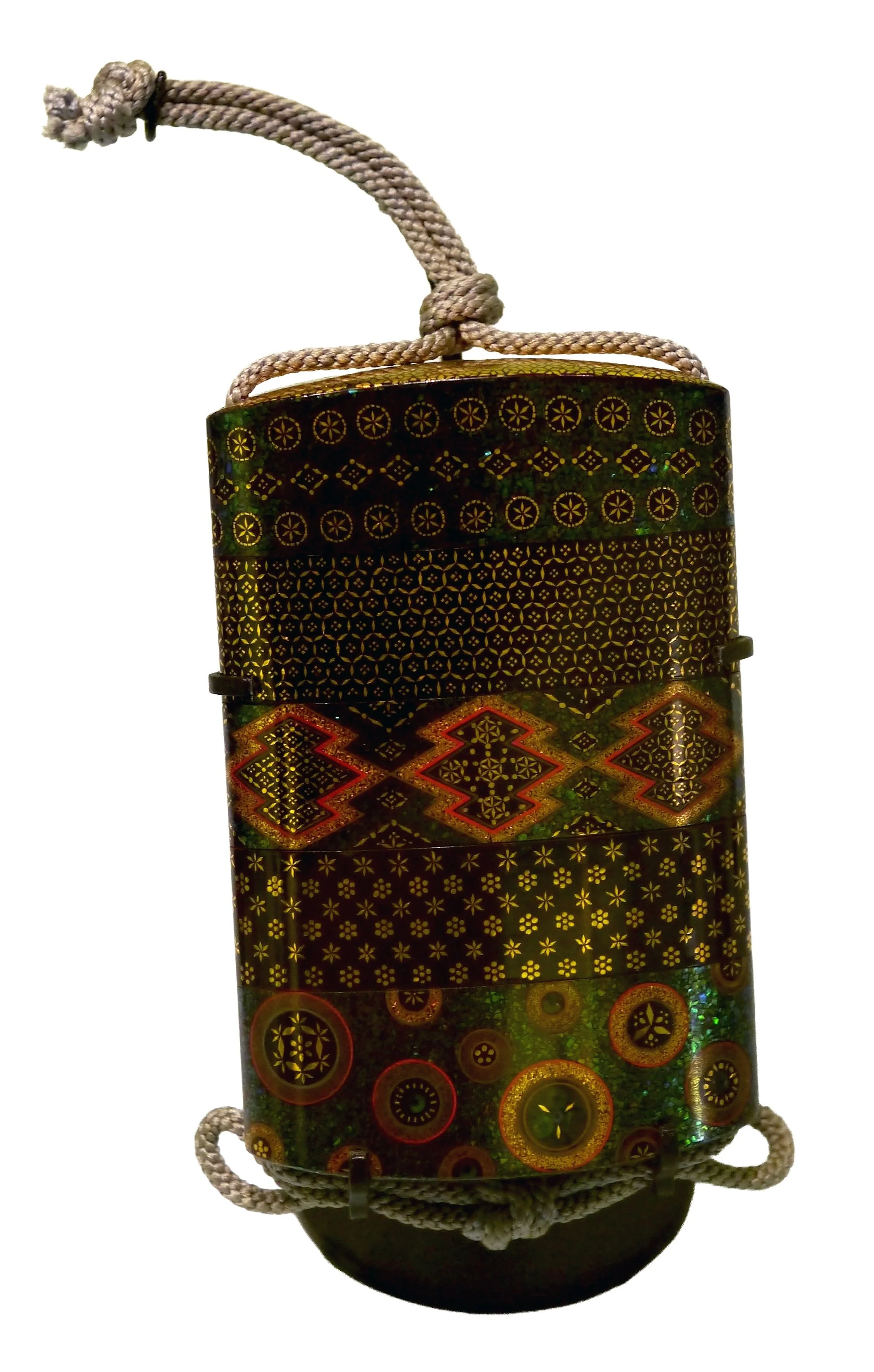
Inrō (tiered container) 1800-75, Japan. Black urushi with mother-of-pearl and gold foil inlay and red, gold and silver maki-e.
Lacquer - it is useful to note here for those not familiar with its origins - is extracted from a tree in the form of sap, notably the species Toxicodendron vernicifluum which also known as the ‘lacquer tree’. The sap is refined through a process of filtering to remove any impurities. It is then dehydrated to reduce moisture content and refined again by kneading to control the viscosity. A final stage of ‘resting’, to settle the material and allow any air bubbles to rise out of the liquid, is vital to produce a highly controlled natural resin mixture, or urushi (漆) as it has become typically known in Japan. While the term urushi originates from a native Japanese word, in its written form as Chinese character, it is pronounced qī, meaning simply ‘lacquer’ or ‘lacquer tree sap’. In its natural form it is either black or deep red in colour, but pigment can be added, which is a practice more commonly found in contemporary urushi. This organic, highly pigmented material is not to be confused with modern synthetic versions of lacquer, the difference between which can easily be discerned by smell alone.
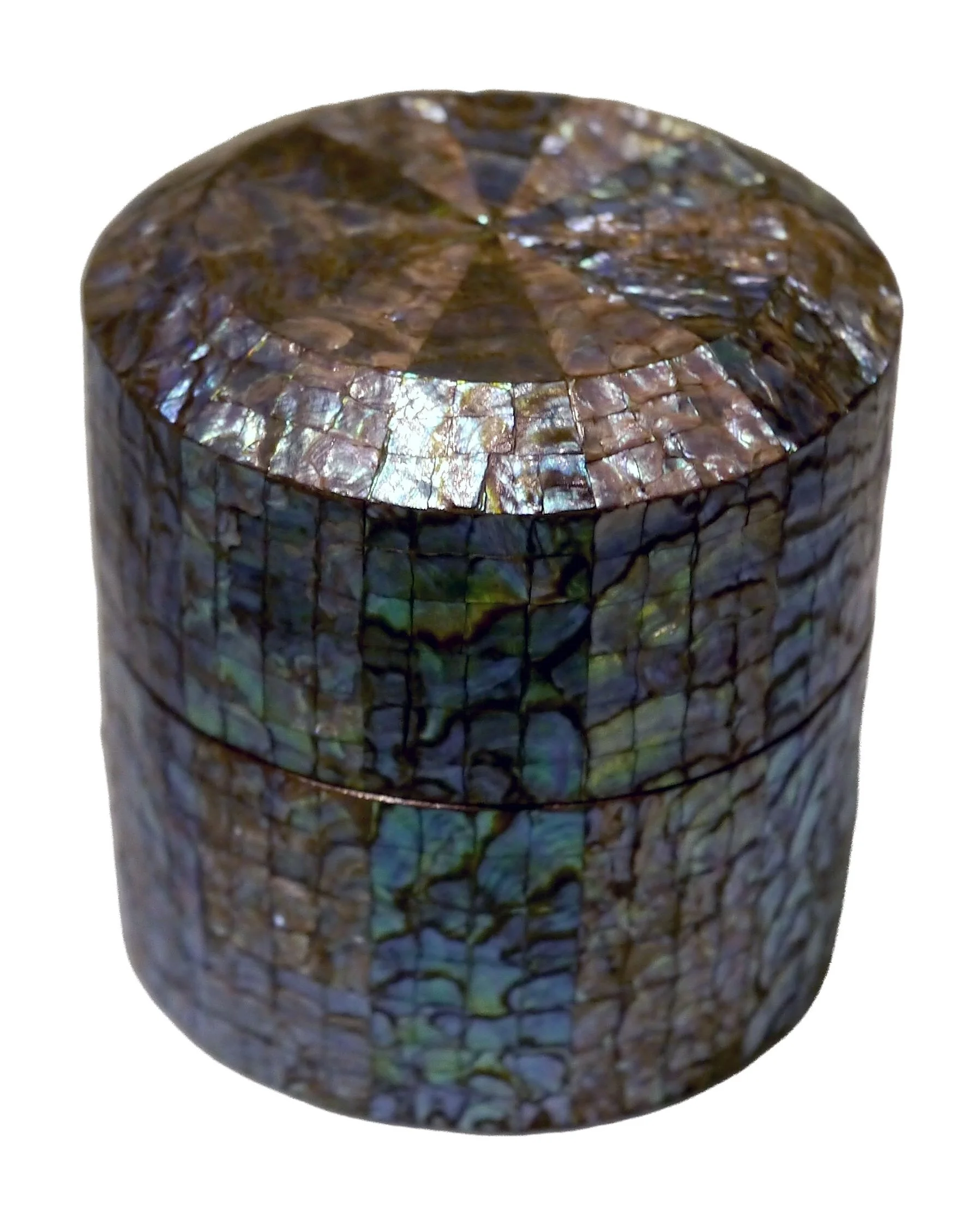
Tea Caddy circa 1977, Kuroda Tatsuaki (1904-82), Kyoto, Abalone shell and urushi on wood core
Lacquerware has a long and distinct history in both China and Japan. The earliest examples from China date back to the neolithic period and the cultures of the Hemudu (c. 5000 – 4500 BCE) and Liangzhu (c. 3300 – 2300 BCE). These fragmentary, early finds of simple vessels such as bowls, cups and ladles precede an extensive history of highly skilled craft. Lacquerware eventually became associated with elite tastes and the imperial courts. What once began as a practical solution and protective coating developed into intricately carved and decorated art objects ranging from bowls and writing boxes through to screens, furniture and ceremonial items.
Lacquerware techniques originating in China were later introduced to Japan via Korea in the mid-6th century CE alongside the spread of Buddhism and court culture. However, Japan already had a much older lacquerware tradition with archaeological evidence of objects dating to the Jōmon period (as early as 7000 BCE). Therefore, techniques imported during the 6th century refined and expanded an existing craft practice, rather than initiating an entirely new form.
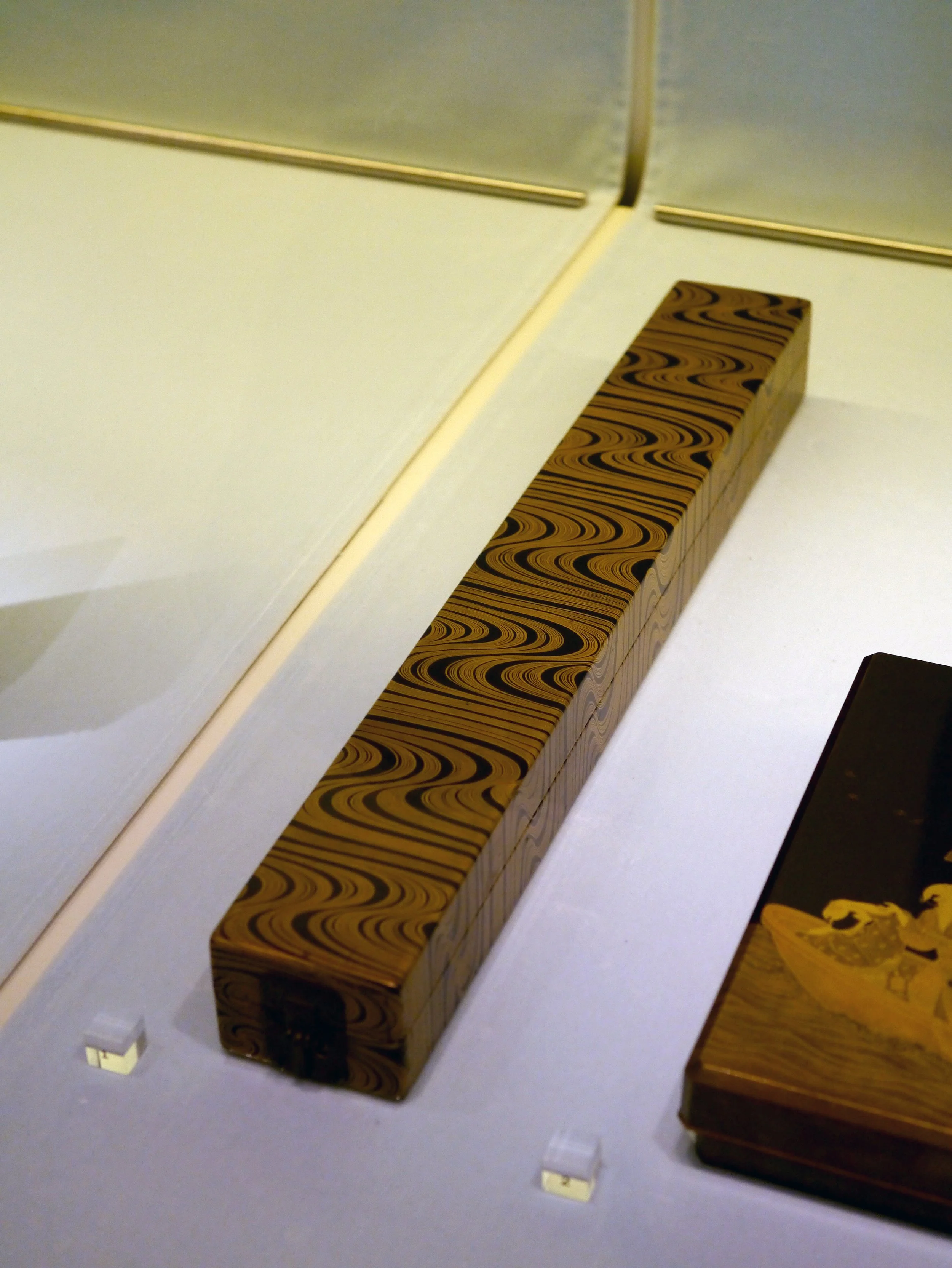
Scroll box, 1650-1700, Japan, Black urushi with gold hiramaki-e (low relief maki-e) on wood core.
Given the long and transcultural history of lacquerware in Japan, it was with a sense of excitement that I approached the urushi exhibition at the Victoria and Albert Museum. I knew that I shared Dr. Masami Yamada’s enthusiasm for curating contemporary objects in direct relationship with their historical precedents. A gesture that makes sense in the broader museum context of the Toshiba Gallery. However, at the time of visiting, I was not aware who had curated the exhibition, but I discovered a strong hint in the form of exhibit No.1 in the maki-e themed vitrine; an unauthored scroll box dated to between 1650-1700, made from black urushi with gold hiramaki-e (low relief maki-e) on a wooden core. I had been fortunate enough to view this object three years prior at a handling session hosted by the museum. I also recalled it being described by Dr. Yamada as one of her favourite objects in the Asian collection. The scroll box also remained in my mind as remarkable for the fact that its entire surface is covered in a repeat wave pattern, both immaculate and uniform in its rendering. The design would have required an extremely high level of technical skill to keep the individual lines of the waves distinct from one another, and one false micromovement of the hand might have resulted in disaster. This early example of maki-e technique (literally meaning ‘sprinkled picture’) later became a central type of urushi art which was cultivated by patronage and the elite. Formed by sprinkling various metal powders - commonly gold - into the wet surface of the lacquer, motifs and designs often reflected the period of their making, referencing literature, stories and responding to ever changing aesthetic trends.
Situated in direct juxtaposition to the scroll box is Massive Flower, 2012, a contemporary maki-e box by the artist Murose Kazumi. While the exhibition vitrine attempts to portray a chronological development in the genre of maki-e, scroll box here is no less impressive than Massive Flower, and it is compelling to think of them as materially related, as well as formally, in the sense that pattern is endlessly repeated to the point of abstraction. As with many of the refined maki-e pieces, lustrous visual sensation here becomes as important as any intended figurative description. One can’t help but be reminded of Takashi Murakami’s kitsch, end-game concept, termed superflat, whereby all colour, line and form are pressed towards the surface of the image, merging traditional Japanese ‘flat’ painting with more contemporary pop culture. However, Massive Flower is an extremely accomplished example of contemporary maki-e lacquerware, demonstrating why Murose Kazumi is considered a ‘Living National Treasure’ – a designation which began in the 1950’s to support intangible cultural heritage and the preservation of traditional craft skills in Japan. The exhibition display here is particularly successful, suggesting that as much as the history of craft practice can shed light on the contemporary world, so too can the present help us to understand the past with fresh eyes.
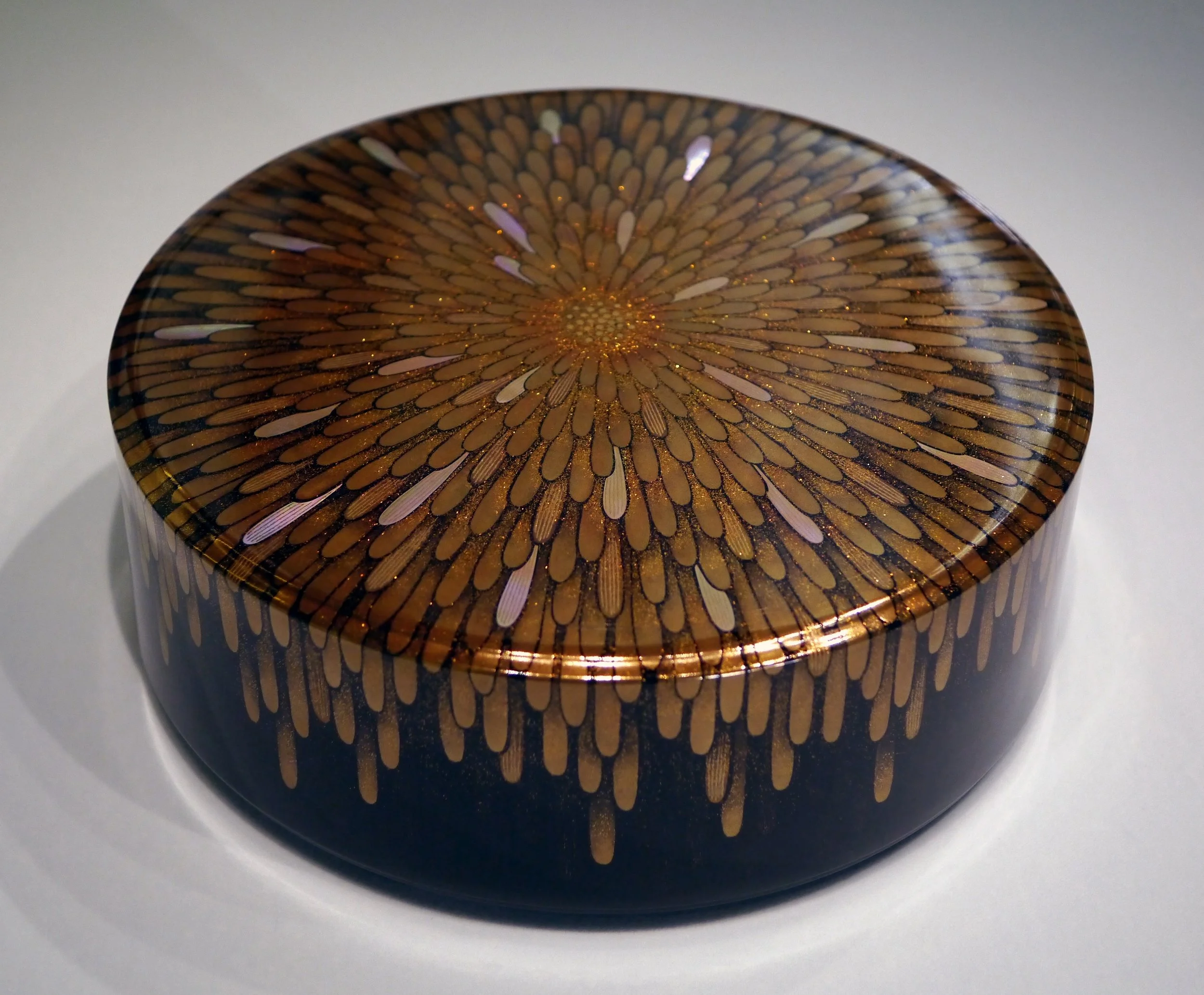
Massive Flower, box, 2012, Tokyo, Japan - Murose Kazumi
Further bridging the worlds of classical and contemporary lacquerware and, arguably the standout artwork in the adjacent ‘shell inlay’ themed display, is a piece by the maker Terumasa Ikeda titled Order, 2024. Made in Kanazawa, a regional centre known for lacquerware, the work brilliantly blends contemporary iconography and techniques with a medium steeped in a rich cultural history.
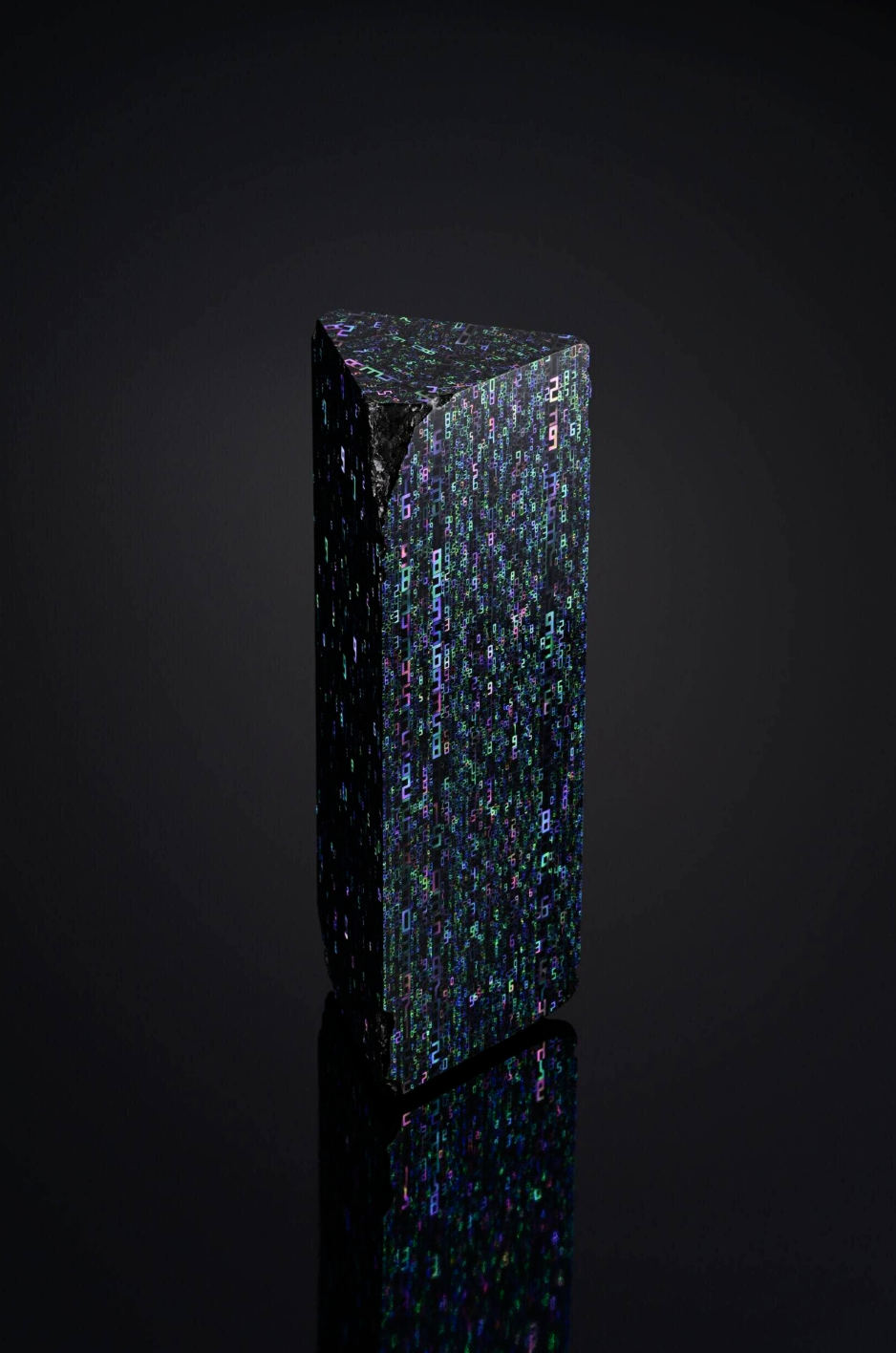
Order, 2024 Kanazawa, Ishikawa Prefecture, Black urushi with abalone and great green turban shell inlay on wood core - Ikeda Terumasa (born 1987)
Shell inlay, or Mother-of-pearl as it is often called, is the inner layer of mollusc or abalone shell. The shells have been used as inlay material for lacquerware in Japan since the technique was introduced during the 6th century from China. Now commonly practiced and termed raden, shell inlay developed in tandem with the ‘sprinkled picture’ or maki-e technique and the two were often employed together as localised methods, which later became regional styles.
Like many of Ikeda-san’s works, the lacquer finish here is jet black and highly polished, recalling in some way the screens or surfaces of our own technological devices – the now commonly carried ‘containers’ of modern-day society. Fragmenting across the surface of these containers are hundreds, if not thousands of numerical digits, stretched out in a linear fashion, almost as if arranged by machine. These digits, which are laser cut from iridescent mother of pearl, shimmer and catch the light in an otherworldly fashion. So much so, that one is simultaneously reminded of Aldous Huxley’s notion of the ‘antipodes of the mind’ and the iconographic, digital rain of the popular film, The Matrix. The holographic quality of the abalone shell under museum lighting brilliantly recalls the sensation of a pixelated screen, with the form of the numbers appearing mysteriously from the black mirror-like surface. Rather than honing the object to a level of complete perfection, the artist has chosen to include abrupt ‘errors’ or disruptions to the otherwise perfect surface. A technique known as kawarinuri, the disruption serves to break up or artificially weather the surface, creating the impression of an unwritten future event which has perhaps since past. There is a feeling of happenstance or beauty in imperfection here, a concept with widely permeates various other Japanese craft traditions. A more in depth exploration of the work of Terumasa Ikeda can be found in an interview here.
Further highlights of the exhibition include a small vitrine at the entrance dedicated to four artists who have been designated Living National Treasures for kyūshitsu or urushi application. The designation of the act of lacquer application is revealing, in the sense that it emphasises process itself to be of value, as much as the material artefacts that remain. After all, without the performative act of making, there is no opportunity for the transmission of these valuable craft skills. The status of Living National Treasure for kyūshitsu requires mastery of urushi application, along with the creation of the underlying base materials. There is a sense then, of the baton being passed to the next generation with the transmission of the skills required to successfully execute the craft. This leads us into far reaching questions of how heritage truly functions; is it something which is bestowed upon us, or rather are we active participants in it ? What are the limits of learning from an object based analysis, whereby objects are severed from the biographical context of their making ?
On a final note, I have chosen to highlight the work one further artist, Mine Tanigawa, who at 36 years of age has found a voice entirely of her own. The piece included has been curated here as ‘sculpture’, and as a natural extension of the craft tradition. The other artists curated within this group have been deemed to be pushing the limits of the material into a realm of abstraction, where the function of the object is less important than the formal qualities of the piece itself. In Urushi Now, this curatorial conceit reveals some interesting results, as well as the restrictions of categorising craft objects in this way. Indeed, part of the success of many of the works in the exhibition is precisely how they intersect with historical precedents, rather than abandoning references to the past entirely. There are very real formal limitations to the construction of large-scale objects using the medium of lacquer, but this is where the work of Mina Tanigawa excels. Where we might expect to see an entirely abstract, functionless form, a reference to the very act of making reveals itself.
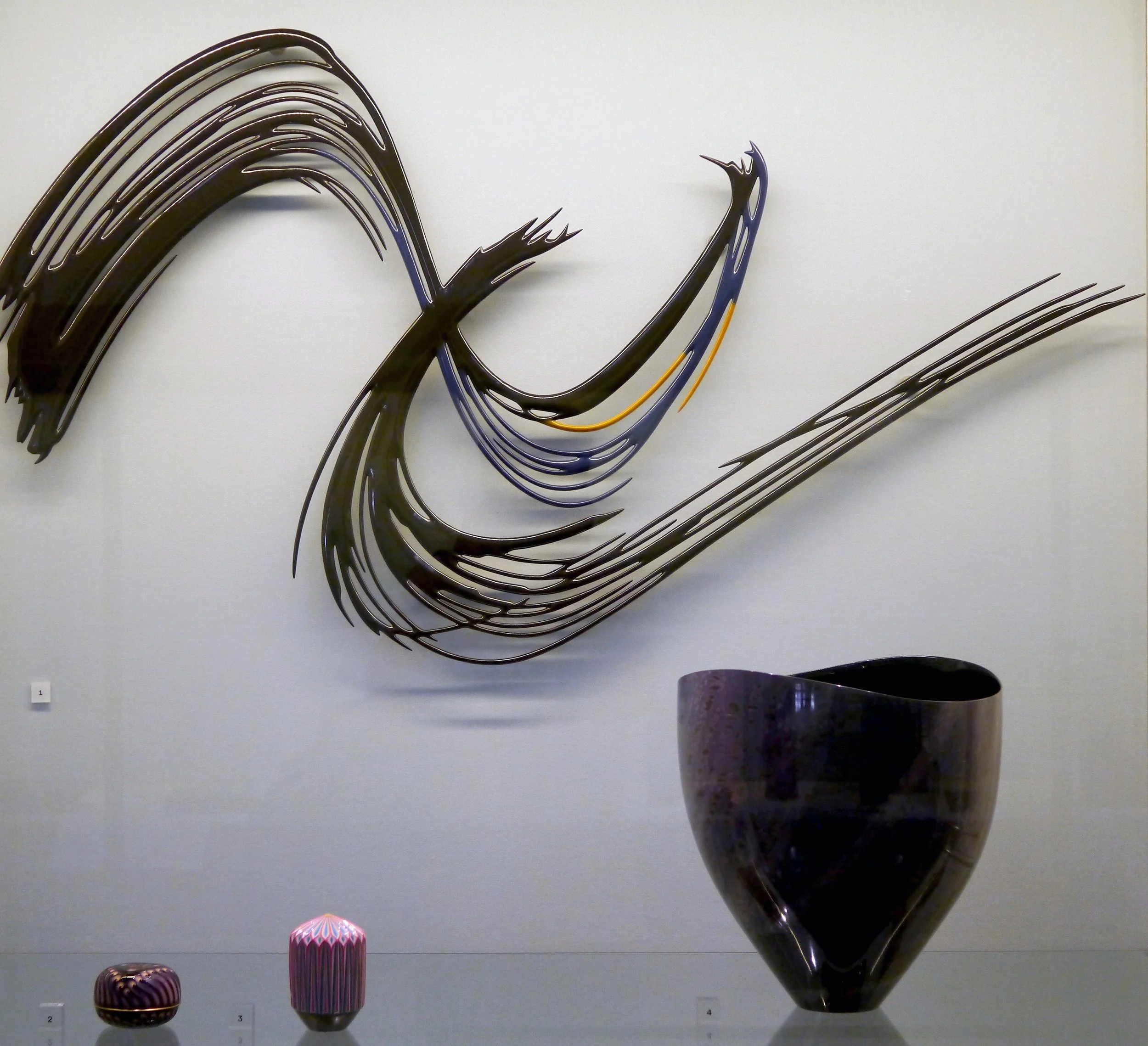
flowing_dg/b/o, lacquer wall hanging, 2024, Kyoto, Japan -Tanigawa Mine (b.1988)
Made from spontaneous marks laid out on paper using a brush and ink, Mine selects, edits and then enlarges these brush marks to create a support structure for the application of lacquer. Due to its scale and nature, this support is extremely brittle and fragile, requiring large amounts of sensitive preparation and reinforcement before it can be worked upon. Once complete, various pigments are tested and adjusted. A balancing act emerges, due to the unstable nature of the lacquer and the variations in tone that occur throughout the drying process. The results speak of an effortless, spontaneous beauty that belies the labour-intensive process of making. Where we might expect to see a static, functional object, we see fluid forms that shimmer and undulate through space.
Where we might expect to see an impeccably crafted surface, instead we experience an image that celebrates this wonderfully diverse and rich medium, yet never really breaks from it entirely. Perhaps this is the greatest success of Urish Now more generally, that the cumulative skill of the makers both young and old push this remarkable medium in new and exciting directions, yet never really abandon reflecting upon it entirely. It is a simultaneous acknowledgment of, and break with tradition itself.