
Interview: Fictional Relics - Terumasa Ikeda
by Alex Whittaker, June 2026
Terumasa Ikeda is a contemporary Japanese lacquer artist whose work reimagines the ancient craft of urushi and raden (mother-of-pearl inlay) through a distinctly digital lens. Combining meticulous craft practices with laser-cut shell inlays, he creates shimmering, transcendental patterns inspired by digital code and pixelated imagery. He has exhibited internationally, including at the 21st Century Museum of Contemporary Art, Kanazawa. His work has received the 2023 EGK BEAMS Prize and the 2024 Mitsui Golden Takumi Award, and is held in major museum collections worldwide.
He is currently featured in Urushi Now - Contemporary Japanese Lacquer at the V&A Museum, London, a review of which can be found here.
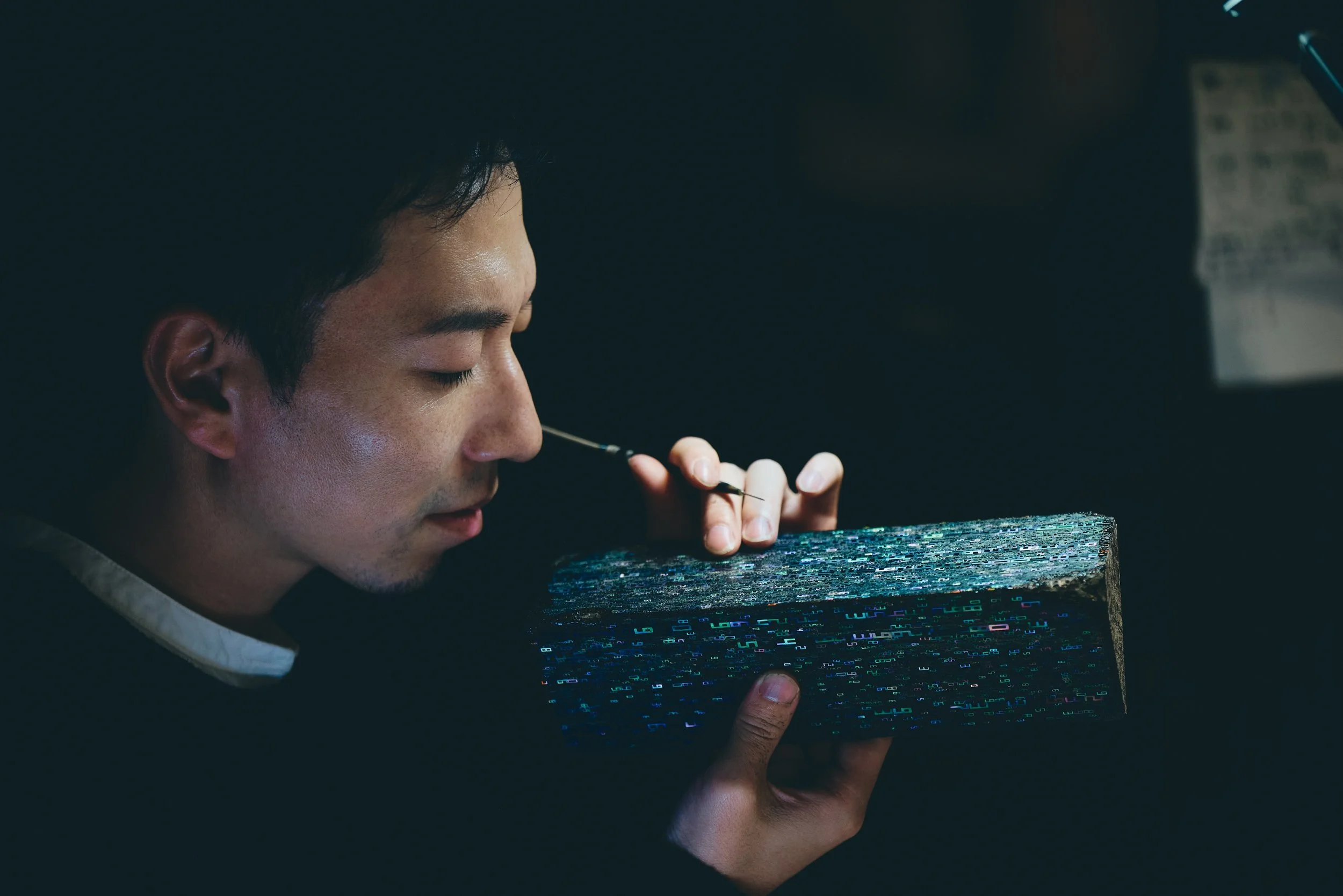
Photo by Akifumi Nakagawa. ©️Terumasa Ikeda/©️Ikeda Deco Ink
(AW) Thank you very much for your willingness to answer some questions today. Through conversation, we hope that we can gain deeper insight into your practice, its relationship to the tradition of lacquerware in Japan and how lacquer functions today within our modern and technological society.
Japanese lacquerware, or urushi, is one of Japan’s oldest and most distinct craft traditions dating back to the Jōmon period, 7,000 years ago or more. Since then, it has developed into its own entirely unique tradition within Japan, from early developments during the Nara and Heian periods, through to being elevated as a luxury, decorative artform during the Edo. Do you see you work as a continuation of Japan’s lacquerware tradition, or a break with the past – or both?
(TI) In Japan, lacquerware began in connection with ritual and belief. Over a long period of time, it gradually moved from the realm of the imperial court, the shogunate, and the warrior class, before eventually reaching a wider public. In this sense, it follows a structure very similar to that of painting and sculpture in the West.
At the core of my creative practice is the idea of making art as something that carries authority. I am fully aware that it is extremely difficult to realize this within the social structures of our time. However, as one way of expressing the kind of sublimity once possessed by academic art, I believe that decoration which reflects “this present age” can offer an important clue.
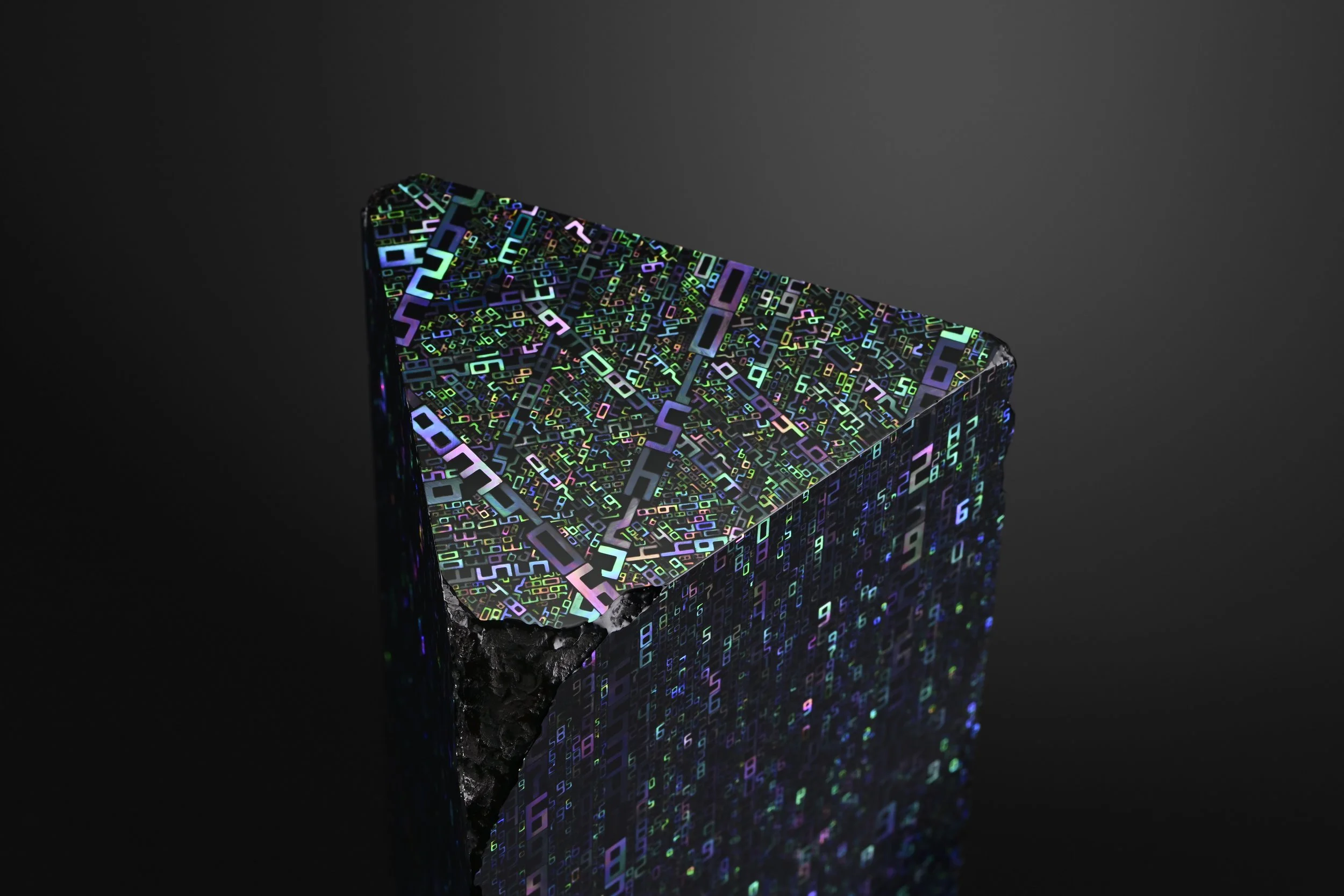
Photo by Akifumi Nakagawa. ©️Terumasa Ikeda/©️Ikeda Deco Ink
(AW) Many contemporary artists and crafts people today are increasingly impacted by digital technology. Whilst technology creates many new possibilities with craft (for example CAD, laser cutting and 3D modelling), your work still has a very strong hand made element. Can you tell us a little more about how technology has affected you work and how you use it?
(TI) Many of the works of art that have influenced me most deeply are those that possess both an immense sense of time and a high degree of completion, like religious architecture. I genuinely believe that the accumulation of the hand, and a sincere, meticulous attitude toward making, can carry a power that appeals directly to the heart — something close to Walter Benjamin’s concept of “aura.”
Of course, I also use advanced contemporary technologies as an extension of the hand. However, I believe that the point at which technology is used must be chosen very carefully.
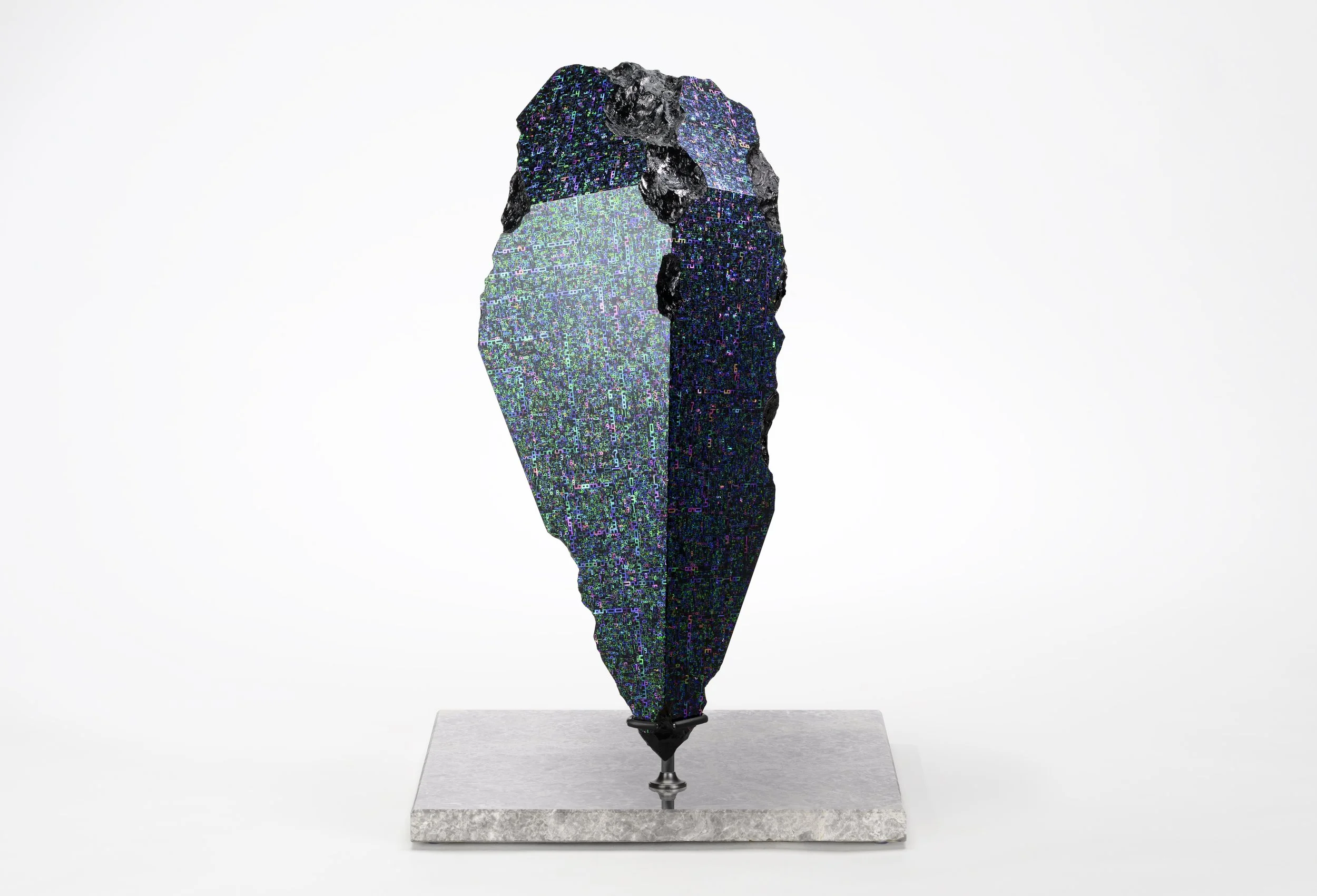
Photo by Akifumi Nakagawa. ©️Terumasa Ikeda/©️Ikeda Deco Ink
(AW) The first thing that strikes me about lacquerware – or indeed any craft-based practice – is just how time consuming and labour intensive it is. Indeed, one of the first reactions I have when viewing your works is often ‘how is this made and how long did it take?!’ Could you tell us how you first became involved with lacquerware production, what was it that made you want to pursue it as a career?
(TI) The starting point for everything was when I was studying architecture in high school and took part in a volunteer project for heritage restoration in Nepal. There, I saw religious buildings decorated with wood carvings, and I visited the workshops where they were made.
That scene felt like a sanctuary untouched by capitalism. Tradition was still alive there as a way of life and work. However, we must find a way to realize that kind of practice within today’s globalized world. The choice of materials and the amount of time devoted to making can be pursued endlessly, but I try to approach creation through the best methods available to me now.
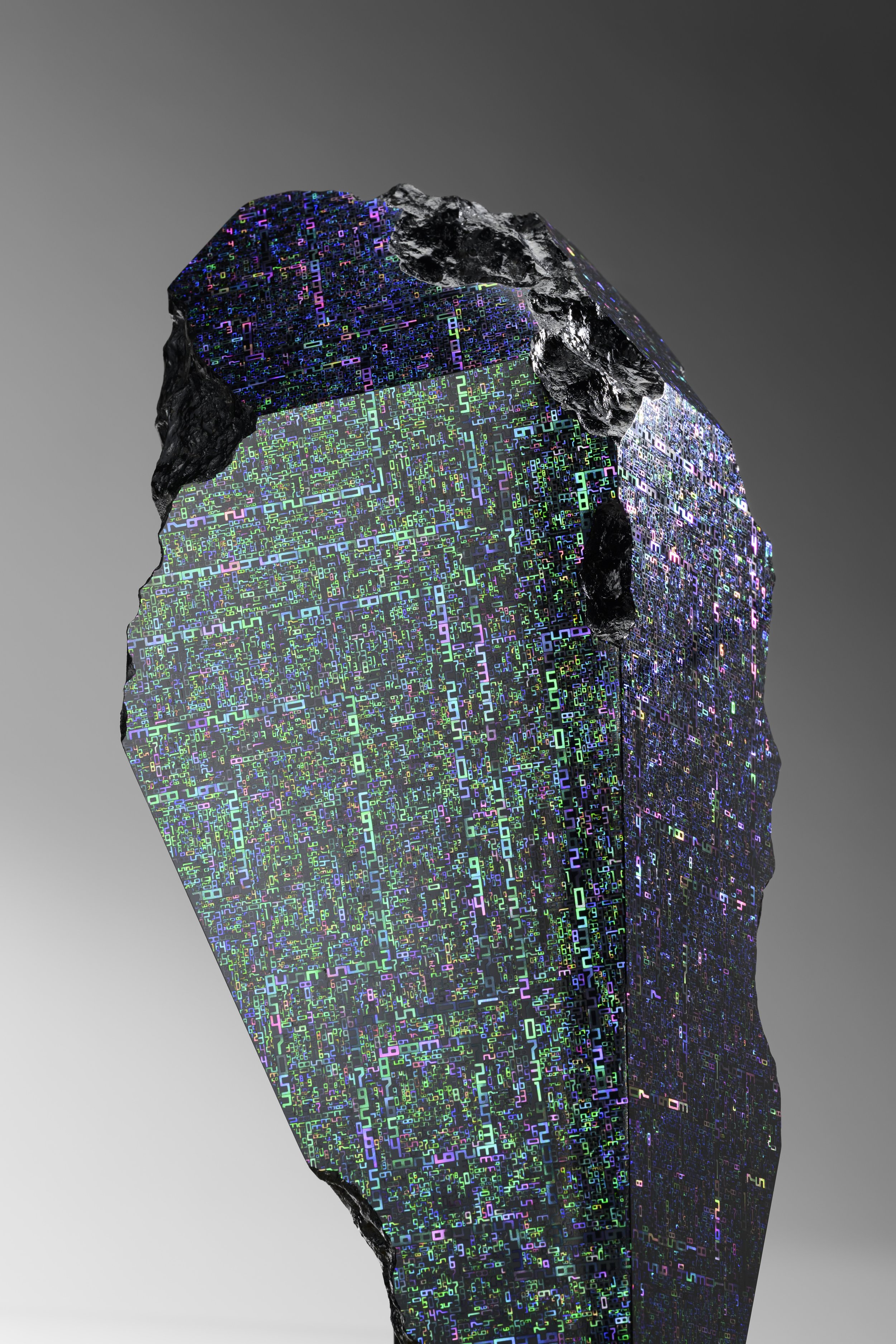
Photo by Akifumi Nakagawa. ©️Terumasa Ikeda/©️Ikeda Deco Ink
(AW) I recently read about the artist Shibata Zeshin (1807 – 1891), who was a lacquer painter and print artist of the early Edo known for his highly experimental approach to materials and technique. His work has been connected to yours through his use of the kawarinuri technique, as well his interest in creating works that appear aged or somewhat degraded. Your works too often incorporate an element of ‘decay’ or imperfection; can you tell us more about that element?
(TI) Shibata Zeshin is one of the makers whom I trust deeply. He was also an extraordinary producer, capable of captivating the samurai class.
In Japan, there is the concept of wabi-sabi. Sabi does not find beauty in something flawless, but rather in the passage of time — in things that have been used, aged, and weathered. The visions I depict are often futuristic landscapes. In order to create a balance between the past, present, and future, I incorporate kawari-nuri, a technique of imitation and transformation.
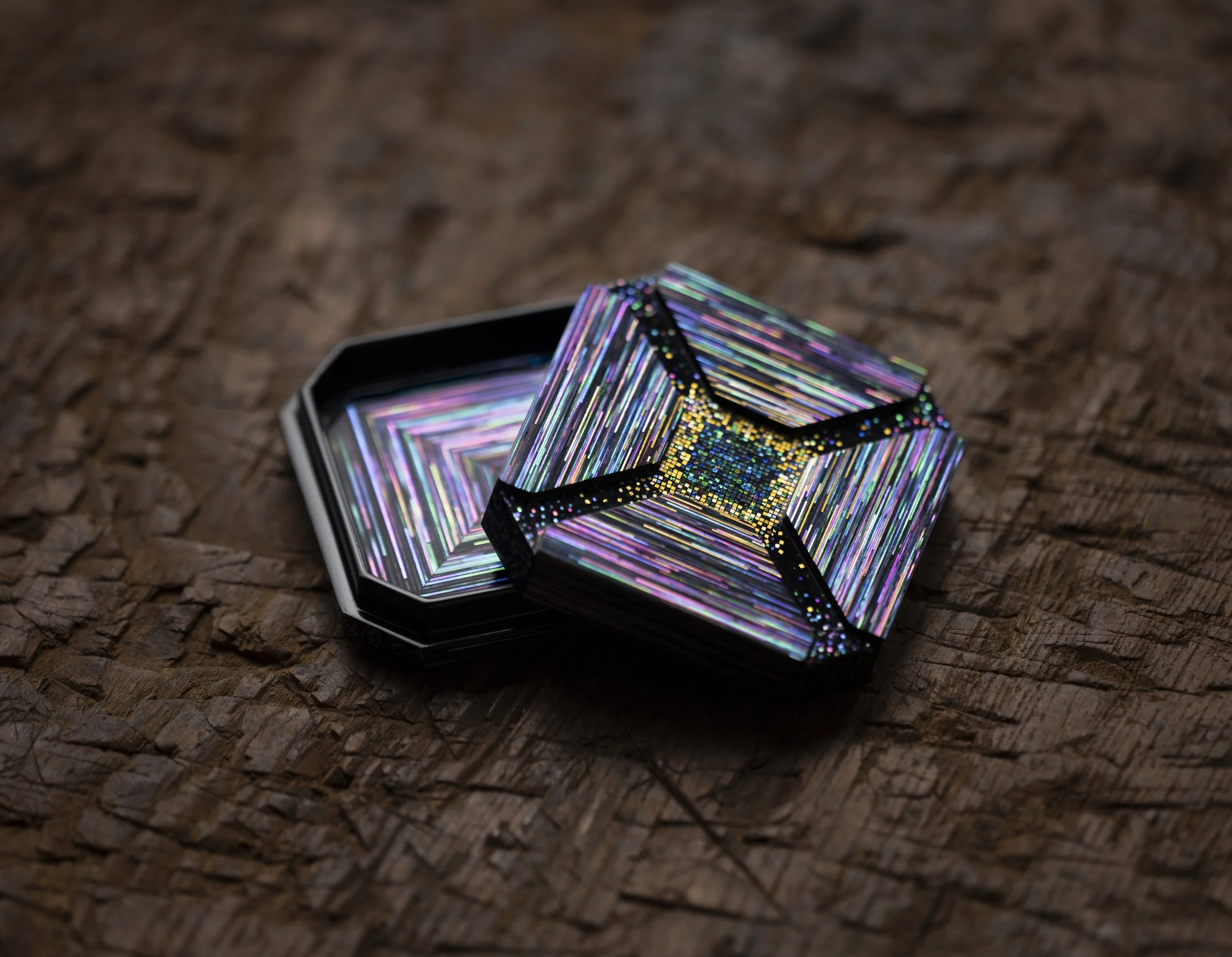
Photo by Akifumi Nakagawa. ©️Terumasa Ikeda/©️Ikeda Deco Ink
(AW) Your work has recently been included in the Urushi Now: Contemporary Japanese Lacquer exhibition at the V&A museum in London. I noticed that the work on display ‘Order, box’ 2024 was curated alongside other historical, functional pieces such as inro, tiered boxes and cups. Is it important that your works have a functional element, or do you see them more as sculptural forms?
(TI) In fact, before the introduction of Western art during the Meiji period, objects without function did not really exist in Japan. The only lacquer-related objects without practical use were Buddhist sculptures, such as statues of Ashura.
I was raised from birth as a devout Christian, and my perspective crosses both Eastern and Western traditions. For that reason, I create my works as sculptures that retain a sense of function.
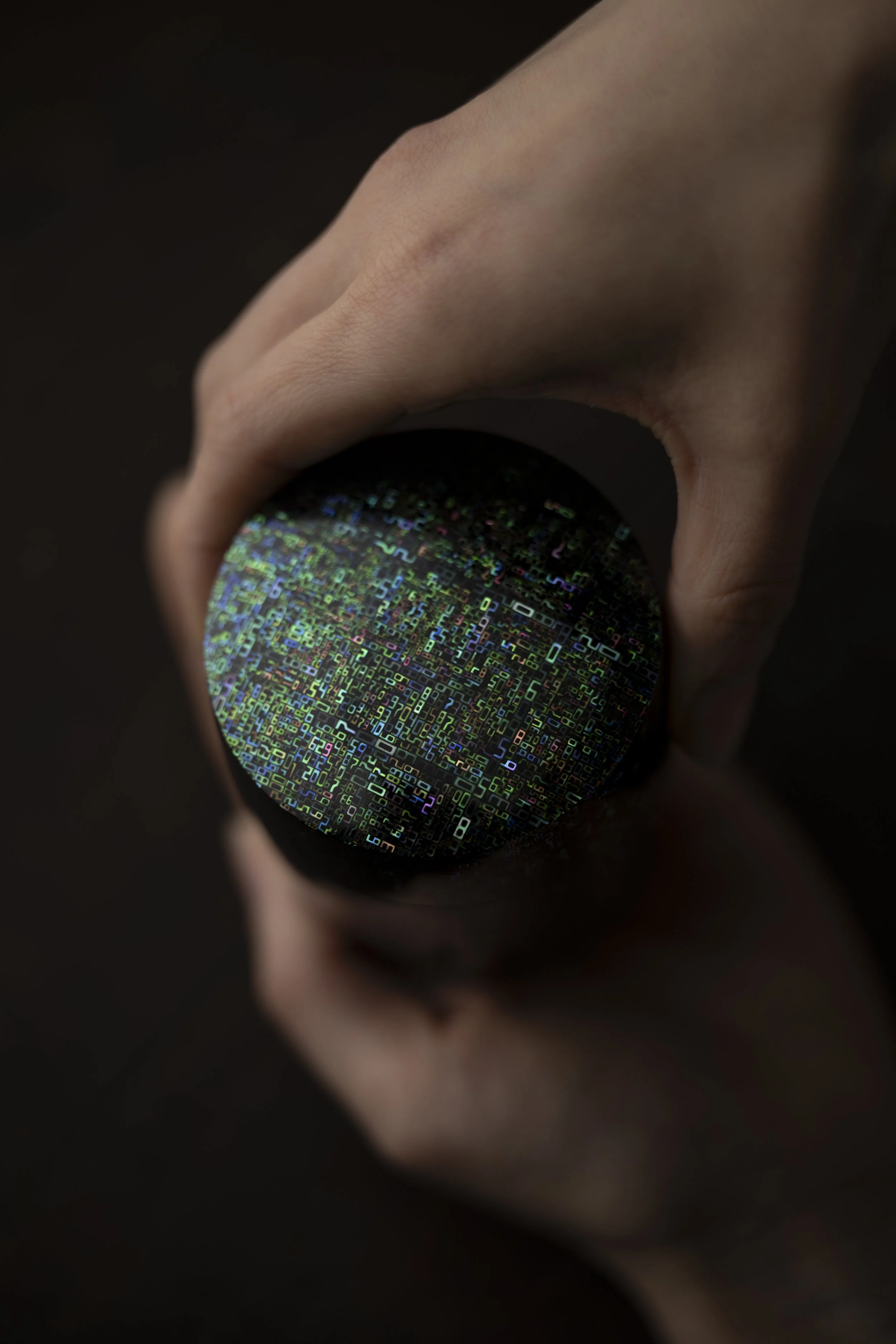
Photo by Akifumi Nakagawa. ©️Terumasa Ikeda/©️Ikeda Deco Ink
(AW) Your work seems unique amongst your contemporaries in that you apply very modern iconography to the surface in the form of numbers, abstract geometric forms and well as imagery that recalls circuitry or networks. Some of your pieces appear to be a clear reference to the ‘Digital Rain’ or ‘Code’ seen in the 1999 film The Matrix. I was interested to know if this is a conscious reference to film culture, or something more general?
(TI) Kogei, or Japanese craft has inherited not only technique and spirit, but also a tradition of transforming nature into imagery. This is often expressed as a kind of formal beauty that can be described as distinctly Japanese.
I also love traditional craft objects, especially those with a strong sense of anonymity. At the same time, I believe there are things that can only be expressed by someone who grew up in this era, surrounded by video games, manga, and anime. I see this as part of a larger movement — one that opens up a new world that is neither simply art nor craft.
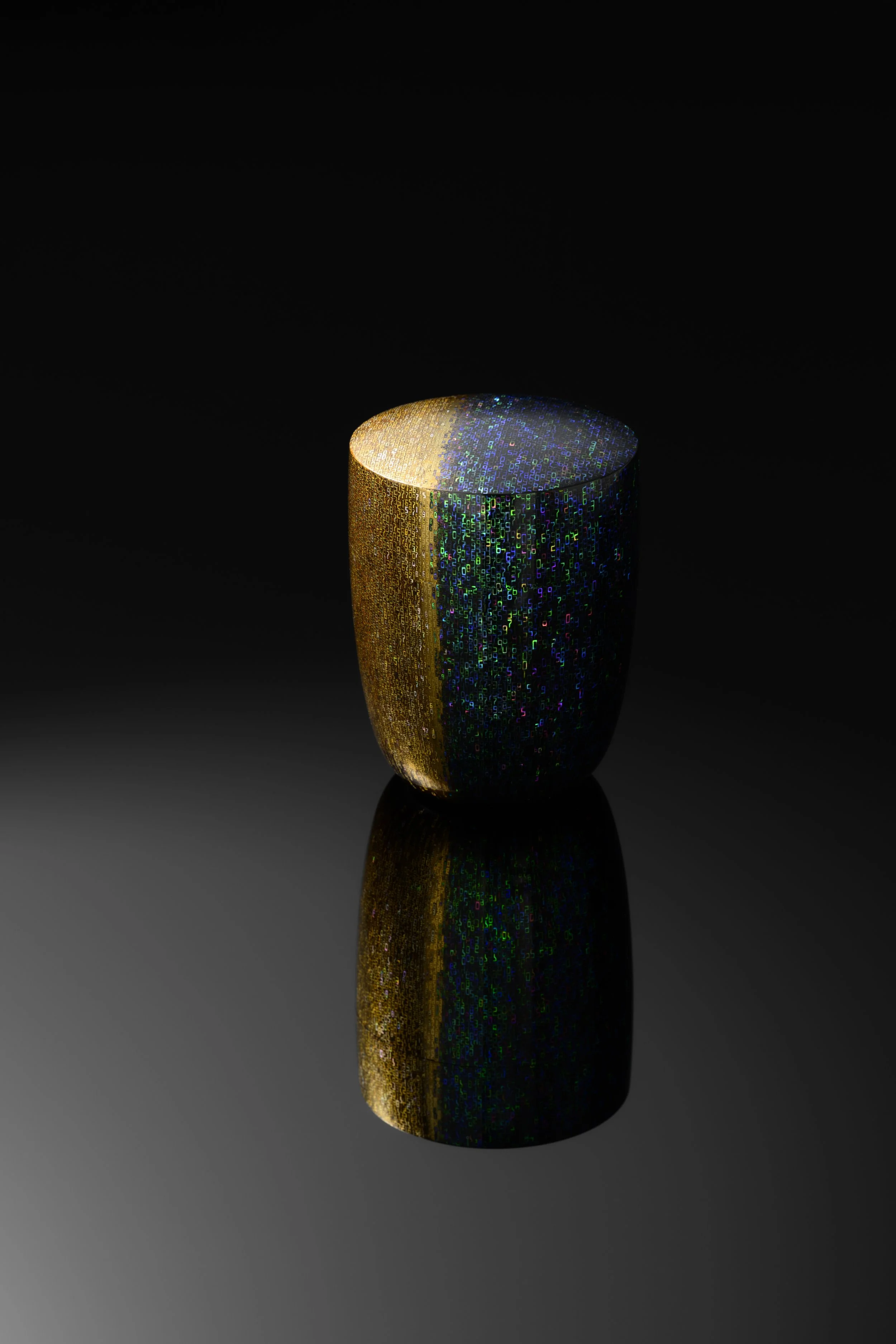
Photo by Akifumi Nakagawa. ©️Terumasa Ikeda/©️Ikeda Deco Ink
(AW) For some of our readers, lacquer might be a completely new material that they have not experienced before. Can you explain some of the strength and weaknesses of this special medium, for example; what do you enjoy about it and what do you find challenging?
(TI) Urushi is the sap taken from the lacquer tree, which grows only in East Asia. It has been used since ancient times, as far back as 9,000 years ago.
It becomes extremely hard and cures through moisture in the air, which makes it possible to apply a wide range of delicate and complex techniques. Another important characteristic is that its curing time can be controlled. For this reason, even today, when many chemical paints and coatings have been developed, I believe lacquer remains one of the most suitable materials for decoration.
(AW) We have spoken quite a bit about the formal aspects of your work, as well as the ideas around them. I’d like to understand more about the materials themselves. I know, for example, you use kiso hinoki cypress as a supporting structure – which is native to Japan. Mother of pearl or abalone shell too, can presumable be source from the coastal waters of Japan. How important is it that you use these local materials in your work, and do they have a meaning and language of their own?
(TI) I have always tried, as much as possible, to use lacquer and wood that share the same place of origin.
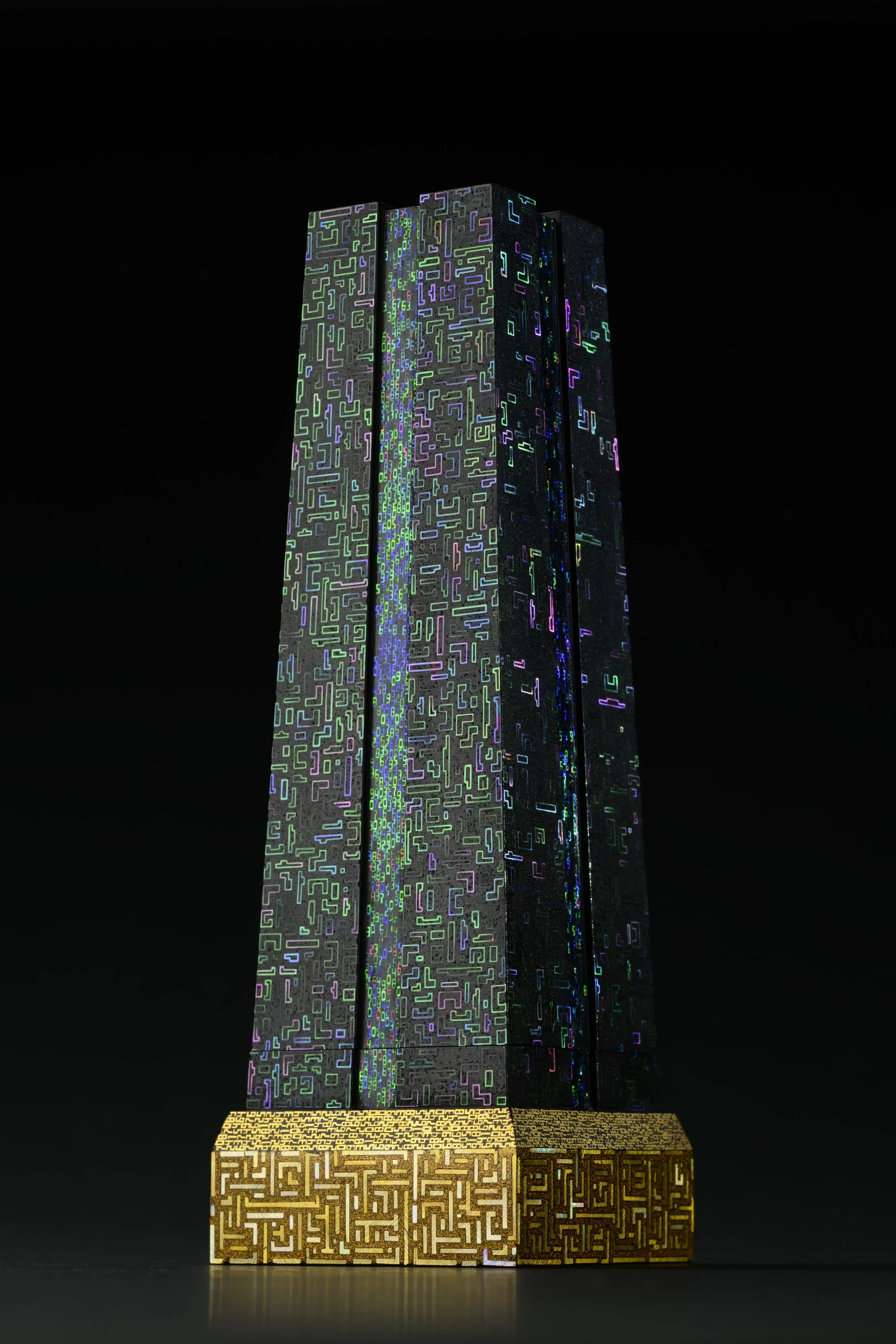
Photo by Akifumi Nakagawa. ©️Terumasa Ikeda/©️Ikeda Deco Ink
This comes from what I have learned through the 1,200-year history of lacquer art, and it is also a responsibility toward the future 1,000 years from now. Wood, in particular, is a material that changes according to its regional environment. For that reason, I pay very close attention to the compatibility between materials, as well as to risk management when transporting works to Europe and other regions.
In this respect, I have learned a great deal from exported Japanese lacquer objects, including those in the collections of the V&A Museum, the Rijksmuseum, and the Marie Antoinette collection.
(AW) As an artist who has found a new voice for lacquerware, what do you think the future looks like for the practice of lacquer in Japan?
Although I have studied lacquer art and focused my practice on it, I am also interested in historical forms of making more broadly, such as ceramics and metalwork. I would like to work with them someday, although I do not know how far I will be able to go within my lifetime.
For that reason, my activities are not limited only to lacquer. I hope to help create a world in which people turn their attention to forms of making that have continued to exist across the world over long periods of time.
History is only what can be observed from our present position. Many things have been lost, and they are not easily salvaged. The things that have survived did so because the makers who passed them on, and the users who protected them, found value in them.
Without being misled by the speed of contemporary society, I continue to pursue art whose value remains universal and unchanged.
Pavilion with like to sincerely thank Terumasa Ikeda for participating in this interview, as well as support staff for text and images.
For more information about the work of Terumasa Ikeda, please find a link here.
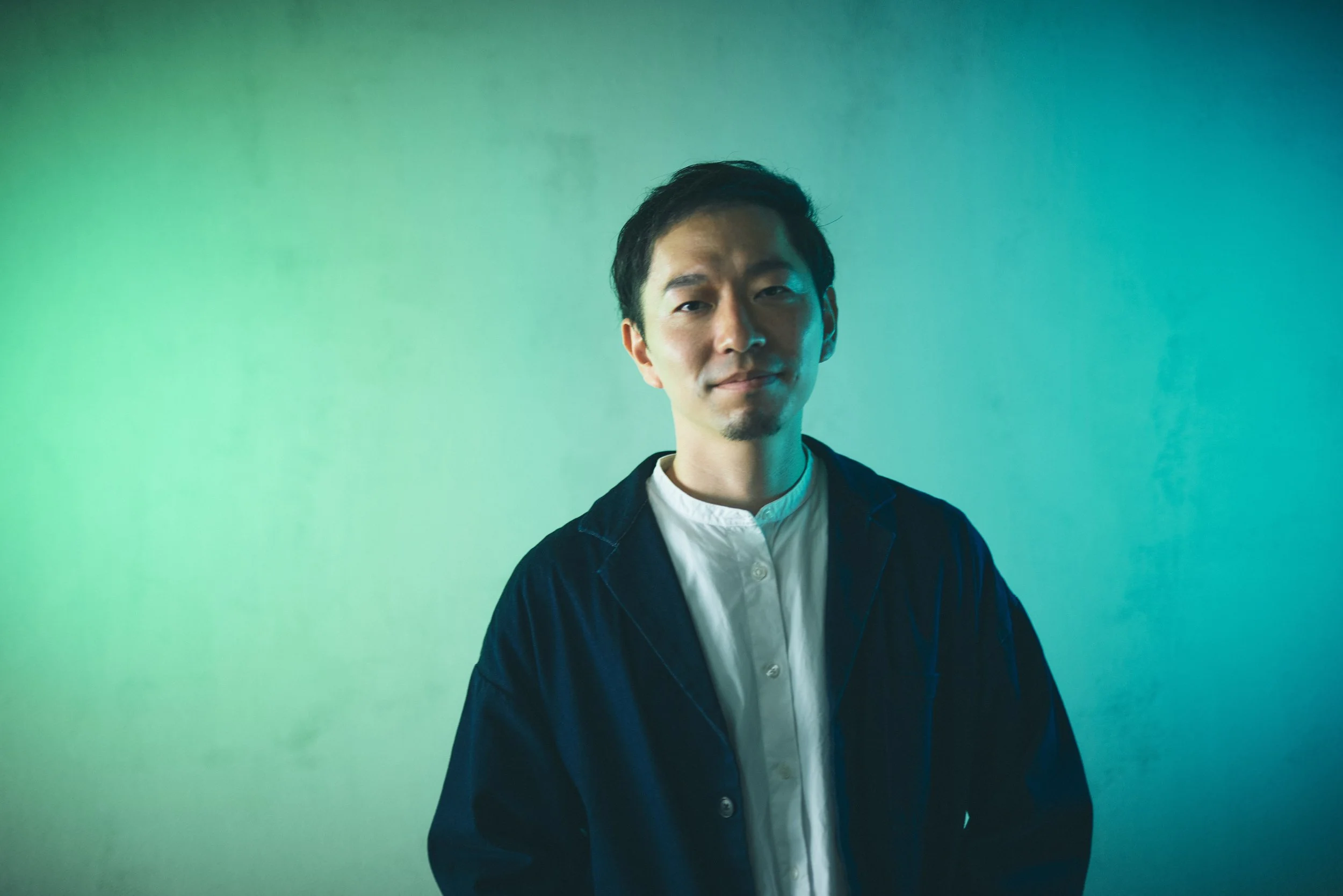
Photo by Akifumi Nakagawa. ©️Terumasa Ikeda/©️Ikeda Deco Ink