
CHINESE SNUFF BOTTLES OF STONE, PORCELAIN, AND GLASS BY MARCUS B. HUISH LL.B. M.J.S.
A delicate pinch ! Oh, how it tingles up
The titillated nose, and fills the eyes
And breast, till in one comfortable sneeze
The full collected pleasure bursts at last !
We were thrilled to discover this fascinating pocket book when trawling through the archives recently. Written by Marcus B. Huish and originally delivered to a meeting held during 1895 at Limmer’s Hotel in London - dubbed the ‘dirtiest hotel in London, despite being popular with the wealthy elite. Huish was a barrister, writer and art dealer in late 19th century London and editor of The Art Journal from 1881 - 1892, as well as managing director of The Fine Art Society and Honorary Librarian of The Japan Society, London which still exists the this day.
The book is remarkable for providing a synopsis of one microcosm of Chinese art - the snuff bottle - but in particular focussing on the use of various types of material, their symbolic value and connection to chinese culture at the time. Not only is rare to find original accounts from the period and it makes for some lively reading, as well as providing a primary, first hand account of how these remarkable miniature collectibles were understood in Europe at the time. Perhaps most revealing is the appendix, which we have chosen to republish below. Here Huish leans on his friend Mr. Thomas Child to elaborate on the use of snuff in Chinese society as well as expanding on the use of colour to celebratory effect in the arts of China more generally - a fascinating read. Click on the button below for a direct link to a scanned version of the full publication, available on e-yaji.com.
APPENDIX.
CONCERNING THE USE AND SUBSTANCE OF
CHINESE SNUFF BOTTLES.
A THOUSAND and fifty years ago a Chinese Emperor, one Shih Tsing, issued an order that in future the porcelain for his palace should be "blue as the sky after rain when seen between clouds." The fact is interesting as evidence of the lengthy period during which colour has been in fashion with the Celestial, and how sensitive and educated the higher orders were, even so long ago, concerning the decoration of their household commodities. Since then the taste has not changed, and in no particular are Chinese works of art more remarkable than for the range of colours which find a place in them. Not only for centuries past have experiments been conducted for producing the purest colours, but success has been attained in an unsurpassed degree, and varieties have been produced which words have almost failed to express, and which have had to be likened to moon-white, sun's rays, and other ethereal hues.
The snuff bottles which have been utilized as a text to the discourse which precedes this have not only an interest as illustrating this national taste for colour, but as doing so by natural as well as artificial means. For not only have we the manufactured tints, but all the loveliest hues which Nature has given to Mother Earth. From her has been gathered a colour scheme not less brilliant, and oftentimes more artistic than that produced by the wit and skill of man.
It is little wonder, then, that as modern taste progresses, the acquisition of these beautiful specimens becomes more general, and that they promise in time to be as much sought after as their larger and more important brethren which have been created by the talent of the finest potters the world has produced.
I propose in this Appendix to give a short notice respecting the purpose of these bottles, and the materials of which they are composed.
The manner of taking snuff is by means of a small oval spoon (see illustration, p. 36), either of ivory, tortoiseshell, or silver, affixed to the stopper, and to be found in almost every bottle. Thence it was placed on the thumbnail, or palm of the hand, and so drawn up into the nose.
Mr. Thomas Child has very kindly favoured me with the following information respecting its use. “Snuffing, so far as my observation in North China goes, is not indulged in to any extent by people who are slaves to the habit and cannot do without it. It is rather an elegant luxury of men about town and should be termed a fashion more than a habit.
Of course there are some amongst the middle classes who take it, and I have met a few habitual snuffers, but I have no recollection of having seen it used by the very poor.
“Amongst the elegants, and wealthier classes, who wander about town from one place of amusement to another, killing time with some difficulty, it is quite the thing to carry a snuff bottle and pass it round amongst one's friends and chance acquaintances. One person will consequently vie with another as to who shall have the most uncommon bottle, and it is amusing to see with what pride each looks at his own possession, and with what care he polishes it with his sleeve. I have seen some very curious and elegant bottles, which showed a great amount of ingenuity and cleverness; these were painted inside, through the neck of the bottle, with fair landscapes,¹ by means of a brush tied on a stick: an apt illustration of how the Chinaman, instead of seeking the easiest method to do a piece of work, goes out of his way to find the most difficult.
“I do not think snuff-taking is much practised by ladies, but one sees very little of their private life.
“Everything in China has its district, and I believe that any bottles now made come from south of Peking.
“The Chinese have no pockets in their clothes. Any article is either carried up their sleeve, or in one of their top boots; money, or notes in a case, perhaps inside their dress. The snuff bottle is sometimes carried ostentatiously in the hand, wrapped in a handkerchief, or the piece of stuff which serves for one, but the usual way is to carry it in a satin or silk purse, made by sewing two pieces of material about three inches wide by twelve inches long together, with a slit in the side at the middle for an opening, somewhat like our old purses. This purse would contain the snuff bottle in one end, and cash in the other, and would be tucked through the girdle, the ends hanging down.
“I have never seen herbs used for snuff. Snuff is made by pressing the tobacco leaf very tight, and planing it with a big plane. I know only one shop celebrated for making snuff in Peking. Although Dr. Williams in his book says that snuff is taken from the thumb-nail, I have always seen it taken out of the bottle with the spoon, placed in the palm of the hand, and thence it is rubbed into the nostrils and over the top lip.
“Mongols are great snuff-takers. Amongst the men it is almost universal. The first thing a Mongol does after an introduction, is to exchange snuff bottles, or to hand his over to the stranger, who either takes a little out, or first smells the bottle, and returns it, which satisfies the etiquette of the case. In handing the bottle it is placed between the palms of the two hands, and advanced towards the person with a bow.”
The bottles usually vary in height from two to three and a-half inches; but occasional ones are as large as four and a-half inches high; these were intended for the table and not for the pocket. It is said to have been a rule that the interior of a bottle should hold as much water as would balance the bottle in weight.
It is needless to remark that snuff bottles are not peculiar to China. They have been used in the Western world from Iceland to Italy, and are to be found in India, Madagascar, Kaffir-land, and Morocco. They were also probably used in Japan, although I have not been able to trace them thither.
The materials of which these bottles are composed may be treated of under the headings of Glass, Porcelain, and Hard stones.
Glass is not a native invention, but was brought to China as long ago as the first century of this era in the goods which enterprising travellers in the Asiatic provinces of the Roman Empire carried from Egypt and Syria to the far East.
It can well be understood that the difficulty of transport of this fragile material by land and sea rendered it of great value when it reached its ultimate destination, and we cannot be surprised to find it classed with gold and precious stones. It was in the fifth century that glass was first manufactured in China, and since then the art has been practised until a perfection has been attained which not even the world-renowned Venetians have surpassed.
Its employment, in the case of these bottles, does not date back more than a couple of centuries, but every variety will be found amongst them. All the processes used in Europe are illustrated in their manufacture, one of the most remarkable being the superimposing of colours over each other, and exposing these by cutting away the various layers.
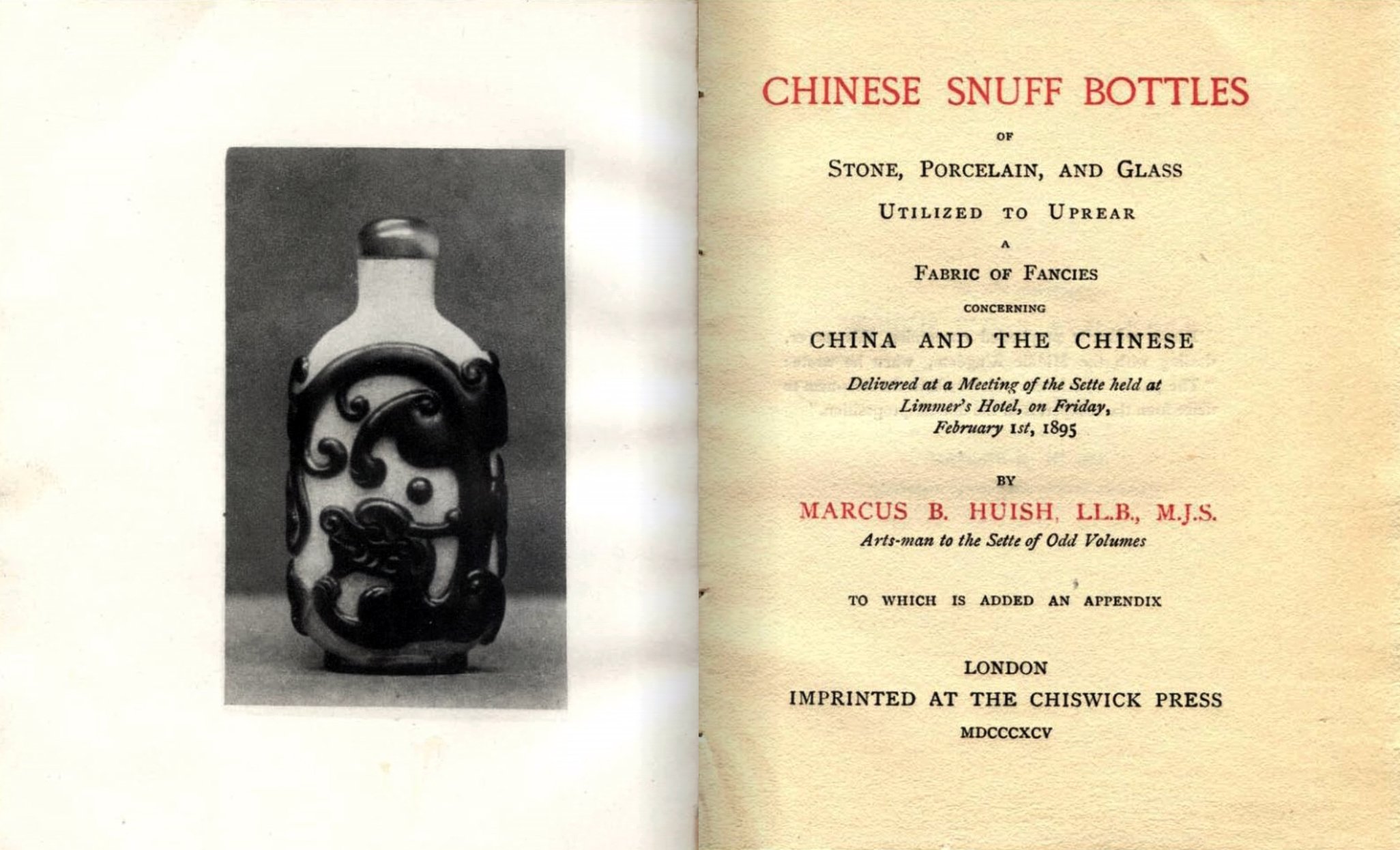
The bottle shown in illustration No. I. (frontispiece) is a simple example of this method compared with many which might have been figured, for there is but one layer of superimposed glass; in this case, namely, a ruby one over a ground-work of frosted white. The design, after being cut, is polished until it assumes a surface which makes it hard to believe that it has not been moulded on.
The Chinese have been most successful in imitating in glass the texture of stones. It is often soremarkable as only to be capable of detection by the test of temperature. They also excel in those varied patterns which we usually regard as exclusively Venetian.
It would be impertinent and impossible to treat of the bottles which are made of porcelain within the limits of an Appendix, for does not the history of that fabric in China extend over no less than seven well-defined periods dating from A.D. 850 to the present time? Besides, it has been dealt with in easily accessible handbooks, such as Franks's "Catalogue." Suffice it then to say, that amongst snuff bottles may be found every variety of the art of Ceramics, from miniature copies of renowned blue and white ginger jars, through all the various families of green and rose, splashed vases and crackled ones.
But if in glass and porcelain the Chinese artists are only upon an equality with their brethren all the world over, in their manipulation of the hard stones they claim a supremacy which is undisputed. It is perhaps not a supremacy about which there is much to boast, consisting as it does, in the main, of a persistency and pertinacity in overcoming the hardness of an intractable material, coupled with an absolute disregard of the value of time. But in these hurry-scurry shoddy days these qualities are in many minds eliciting an admiration which is not to be wondered at, even if perhaps it is hardly deserved.
Respecting the bottles fabricated out of hard stones, I cannot do better than translate a description concerning them which occurs in "L'Art Chinois," by M. Paléologue, Secretary to the Chinese Embassy in Paris, a work from which I have derived much of my information respecting them. He says: "The Chinese have always had a great liking for quartz stones, and the Art of working them, of giving effect to their brilliancy, transparency, rich and harmonious colourings, and their unexpected and various markings, very early reached a high pitch of perfection. This is not surprising when we remember that the art we are dealing with is above everything sensuous, and that the Chinese artist had generally to extract from his work delight for the eyes and touch, rather than a creation which would appeal to the mind and emotions.
"The most sought-after stones are rock crystal, amethyst, cornaline (a cherry red infused with orange yellow), chalcedony of a milky-white cloudy colour with azure tints, heliotrope of a deep green sown with red points, chrysoprase, a pale green, sardonyx of warm red tones, and all the varieties of agate.
"All these stones imposed upon the craftsman even to a greater extent than jade, an endless patience and a prodigious amount of ingenuity.
At every hour of his work he was liable to freaks or flaws in his material opening up under the blow of his tool. Was the stratification regular? Would the piece he was extracting come away readily, or would it detach with it a part that was necessary to the design? At any moment he might, owing to this, have to change a plan upon which he had been working for months. He has perchance started with the idea of using certain markings,¹ and representing a peach and a leaf attached to a stalk. A flaw occurs, and he has to change it into a bursting pomegranate; six months later, when his work is nearly finished, certain red stains arrest his tool; these he has to use for something, and he may have to re-model all his fruit, utilizing these as projecting branches.
"Such conditions of work lend themselves undoubtedly to happy results, and a freedom of composition which are attained in few other materials."
If we refer to the catalogue which was formed by the late Mr. Bragge of his collection of bottles, we shall see what a wide range the stone ones cover. His large array included jade, chalcedony, amethyst, green turquoise, lapis lazuli, Mocha stone, carnelian, agates, jasper, steatite, amber, pearl, malachite, tourmaline, coralline, alabaster, and fluor spar.
Lastly, we come to the material which is most affected and most prized by the Chinese in the manufacture of any article—namely, jade, and which naturally is utilized to a large extent for snuff bottles.
Jade is a heavy, semi-lucent stone, of a singularly close grain, unctuous to sight and touch, and ranging in colour from milky white to deep olive according to the amount of oxide of iron and oxide of chrome in its composition. Its hardness is such that it will cut glass and quartz, and its toughness that it may be cut almost as thin as paper. It is termed by Mayers ("Chinese Readers' Manual," p. 99), K'iung, or chrysoprase, in allusion to the milk-white purity of one of the most highly esteemed varieties, and as a synonym for whiteness or spotlessness.
It is for the most part found in Chinese Turkestan, near Khotan, and Yarkand.
It is difficult to appreciate the excessive value attached to it by the Chinese, and how it can be held in so much higher esteem than many other stones with which it cannot compare; in lustre, for instance, with rock crystal, in colour with sardonyx, in marking with agate, or in surface and translucence with many of the quartz family.
Nor is it its rarity which gives this value; for although faultless pieces are difficult to meet with, the lower grades are produced in a sufficient quantity to take it out of this category.
The reason for its great renown is clearly its imperishability, and hence its use for articles which form part of rites and usages destined in the mind of the Chinese to be handed down from generation to generation in a never-ending succession.
In penning this Appendix, two Oriental proverbs have occurred to me: one Chinese, "Even chaff will yield oil if beaten sufficiently;" the other Japanese, "To preach before Buddha is a great risk." I have endeavoured to thresh out from my chaff a few drops of oil, and these I present to a Sette as august, and I hope as compassionate, as the "Lord of all the world."
¹ The Chinese have always been fond of peculiarly marked or shaped stones. At Shanghai is a rockwork around which are strangely shaped stones brought from all parts of the empire.