
Pavilion Review: Hyakkō 100+ Makers from Japan
By Alex Whittaker - Japan House, London
Located on Kensington High Street, Japan House occupies a prime central London location – just a short walk from Kensington Gardens, the Royal Albert Hall and the Victoria and Albert Museum. Opened in 2018, it represents the third initiative of its kind by Japan’s Ministry of Foreign affairs which previously opened two similar venues, one in Los Angeles and one in Sao Paolo, Brazil. Japan House represents an institutional attempt to promote and expand understanding of aspects of Japanese culture outside of East Asia, with a particular focus on contemporary art and design, food and innovation. The well-received 2024 exhibition ‘Design Discoveries – Towards a Design Museum Japan’ included dialogue with London’s nearby Design Museum and presented a speculative enquiry of what a future museum of design might look like from a Japanese perspective. As well as promoting cultural awareness, Japan House also provides Londoners with access to uniquely designed and crafted items, many of which would be hard to find outside of Japan. In all, the centre attempts to provide ‘an authentic encounter with Japan’, from within the UK.
The latest exhibition, Hyakkō 100+ Makers from Japan continues the focus on art, craft and design by introducing the work of over one hundred craftspeople from regional centres in Japan. The selection of works is expansive, totalling some two thousand hand crafted objects in various materials such as metal, leather, glass, ceramic and wood, all presented alongside a selection of short artistic and philosophical reflections on the concept of craft. The exhibition also includes a wonderfully produced short film which documents some of these craft processes in action, serving to contextualise the objects on display. (A publicly available version of the video is embedded in this article below). There is also an attempt to foreground various histories of folk craft in Japan, while bringing these histories into the contemporary sphere via domestic, day-to-day items that inhabit the lives of their users in ways that art objects simply cannot. Whilst not overtly referenced in the exhibition text, the show does not highlight other well-established form of craft in Japan – for example architectural carpentry and joinery or indeed the now widely practiced Kintsugi (金継ぎ, "golden joinery") which seems to be appearing everywhere now, not least within my Instagram feed. Rather, Hyakkō (which translates as 100 artisans or simply ‘many makers’) is a show about things; tools for people made by people with tools. It is worth recalling here the Japanese word もの mono which is comparable to the English word ‘thing’ yet broader in scope including ‘not only objects and materials, but also human emotions, relationships, time and memory’ [1]. Considered in the concept of craft, もの mono brings about an equivalence between ‘things’ suggesting that our relationships to objects are perhaps just as important as the objects themselves in ‘a form of dialogue between people and nature’. [2]
Aside from philosophical re-definitions of craft, this is an exhibition which primarily focuses on the production of objects for the home. It is perhaps unsurprising then that it has been organised in conjunction with Ryohin Keikaku Co. Ltd. - better known to us in London as MUJI, short for Mujirushi Ryohin which translates as ‘no brand quality goods’. Given the increasing popularisation of crafts from Japan and the exhibition’s own claim that it is ‘a celebration of contemporary Japanese craft aesthetics’, I entered the exhibition Hyakkō, in the hope of getting a deeper appreciation of the crafts of Japan, whilst also slightly sceptical of the idea of a ‘national aesthetic’. The development of visual culture largely ignores national boundaries and, if one digs deeply enough, it becomes apparent that ‘nations’ are better understood as hybrid forms, shaped by the endless back and forth of transcultural flows brought about by trade and immigration. One example of this is the so-called British Arts and Crafts movement; a confluence of inherently international values, primed in part by the advent of Japonism in Europe at the time. Similarly, what we might consider to be distinctly Japanese ‘anagama’ or ‘cave kilns’ – the very technology often used to fire ceramic wares produced in Japan - had their roots in the climbing or dragon kilns of Shang Dynasty China, reappearing in Edo period Japan (1603 – 1868) and again during a later Mingei revival during in the 1920’s – 30’s.
It was with these thoughts in mind, and as a maker of ceramics myself, that I entered the exhibition. My initial focus was on the visual and material qualities of the ceramic wares, particularly those that connected with ideas of ‘folk craft’, as well as those that were made using traditional wood firing methods. If I had any preconceptions, they were to do with the idea of a ‘value judgement’: How does one discern that which is ‘good’ within a discipline that elevates happenstance and the accidental? The Japanese philosophical concept of wabi-sabi relates specifically to the idea that an object doesn’t need to be well-made to be good. The inference here is that we might better appreciate the quiet, understated aspects of life which exist in our day-to-day lived experiences. Beauty here is not necessarily to be found in perfected or idealised forms, rather imperfection and impermanence are appreciated as core aspects of any value judgement. So where does that leave the concept of craft?
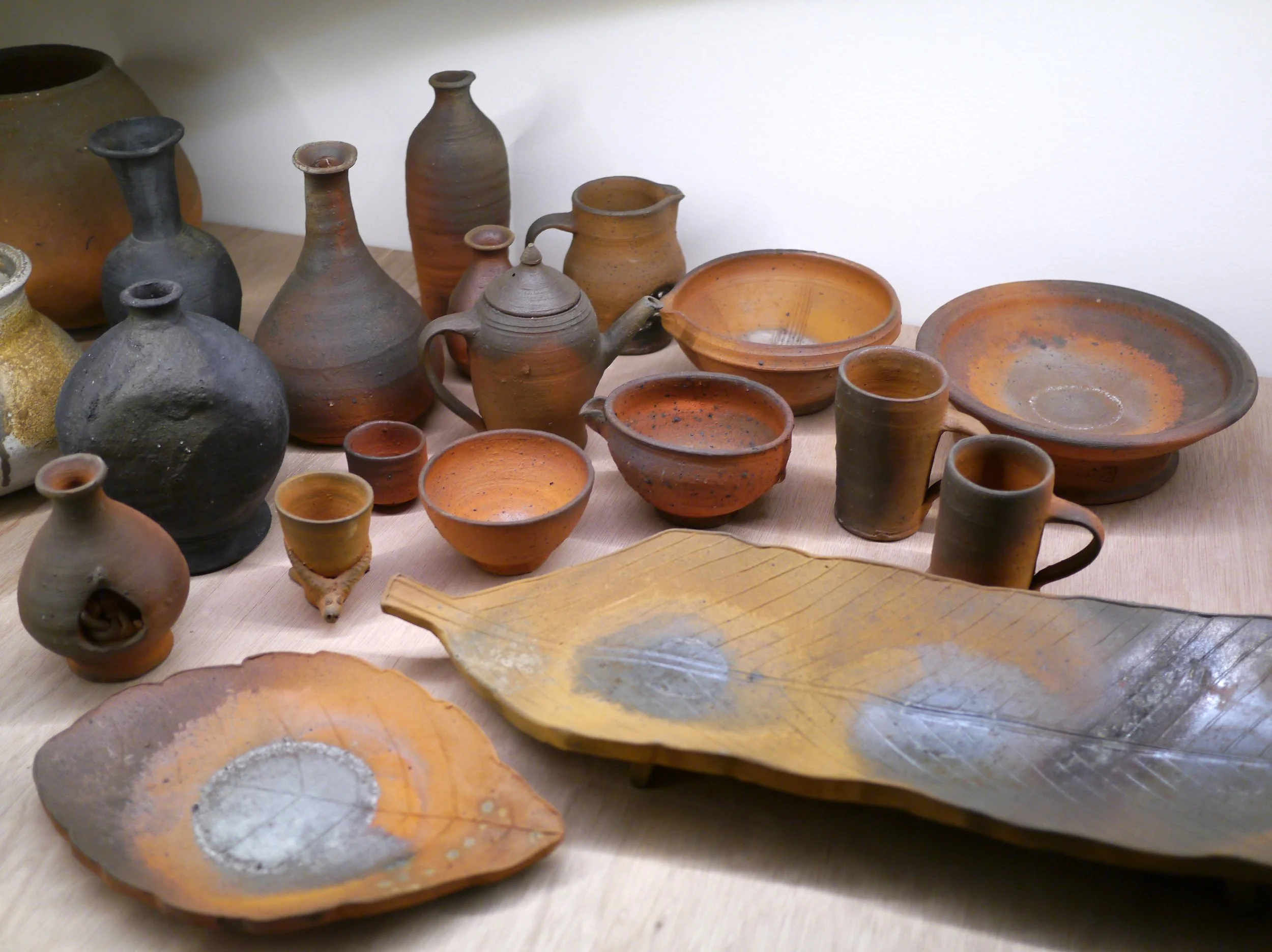
Ceramic works by Morioka Shigeyoshi b. 1948 Nara / based in Wakayama
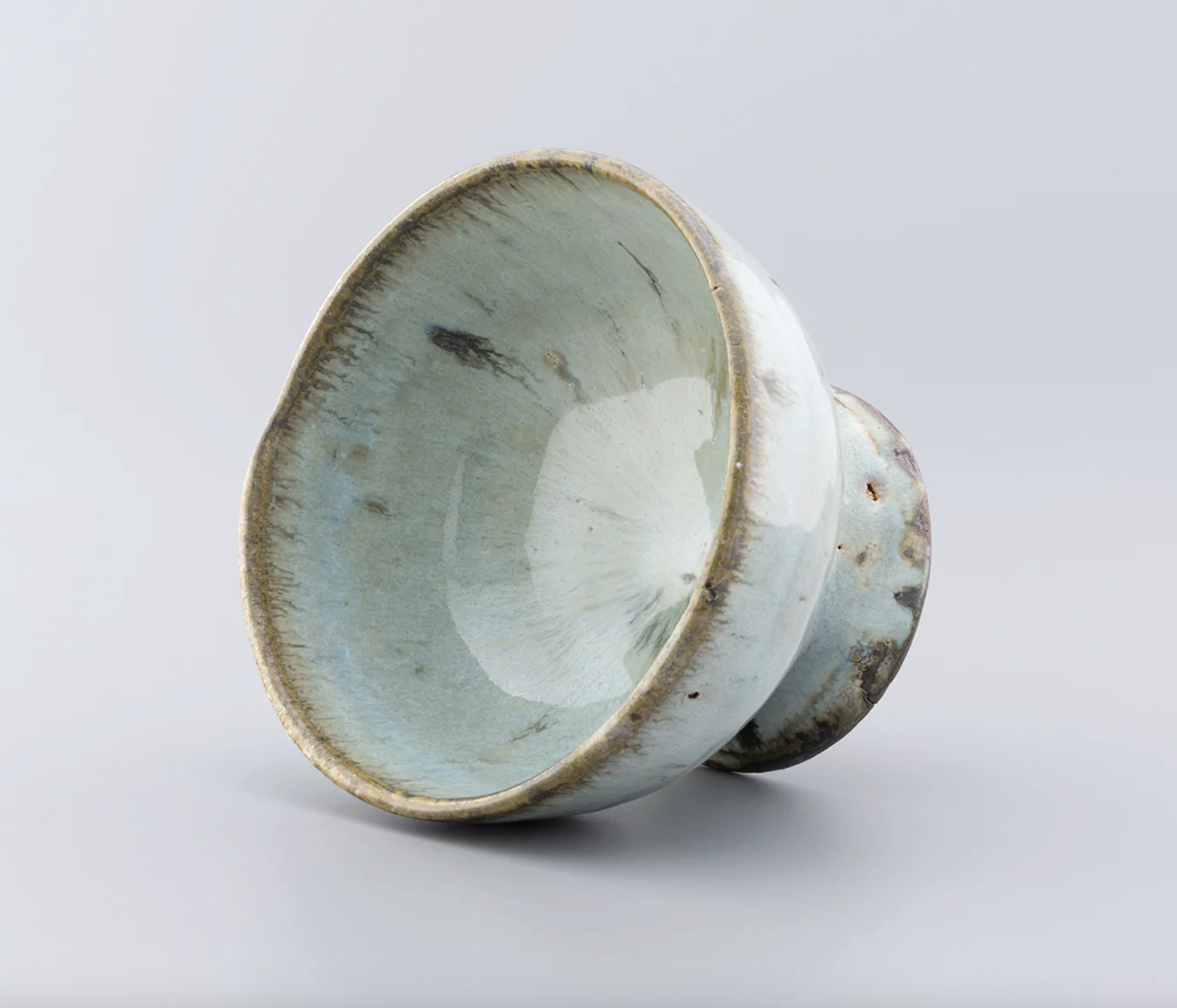
A wood fired piece by Yamada Ryūtarō b. 1984, Saitama / based in Kanagawa
Generalised conceptions of craft often suggest any practice must demonstrate, at least to some degree, the skill of the craftsperson or maker. But does it necessarily follow that the greater the level of skill involved, the better the resulting object? Extolled by Yanagi Sōetsu in the 1920’s Mingei was a folk-craft movement that was inherently ‘of the people’. It put forward the idea that true beauty, according to Yanagi, was to be found in objects that are ‘born not made’. One good example of this is the humble Ido tea bowl, originally used in Korea as a day-to-day vessel for simple foods - a form which continues to be well explored by contemporary Japanese makers such as Yamada Ryūtarō even today. Rustic, earthy aesthetics came to exemplify wabi-sabi values and function as an austere counterpoint to the more ornately embellished Chinese ceramic wares that came before them. Born out of necessity and the very earth from which they came, folk craft vessels connected people to the places of their making.
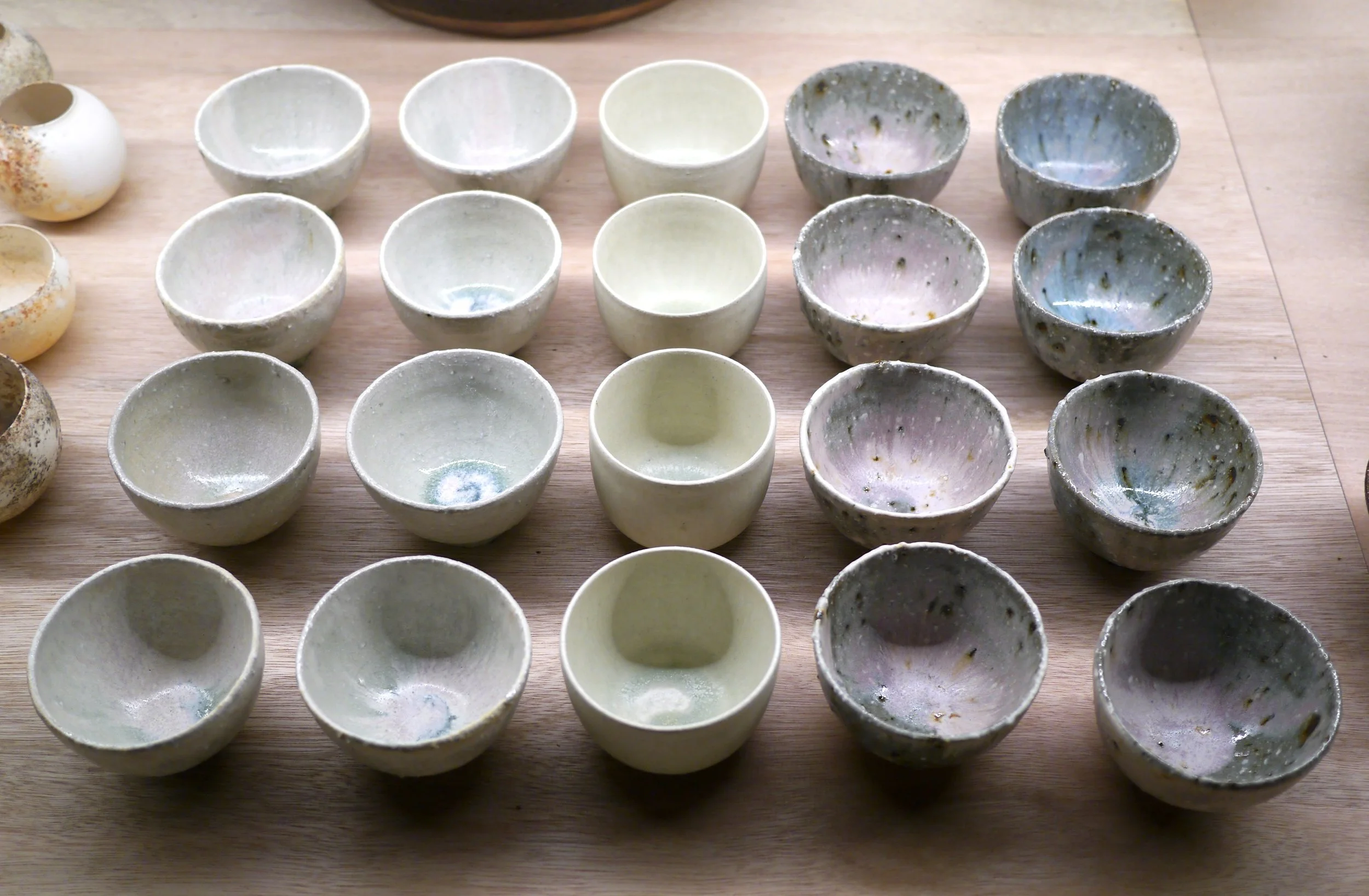
Works by Hasegawa Natsu b. 1967 Tokyo
Upon entering the exhibition at Japan House, the viewer is immediately struck by the physical nature of the display. The space has been kept open plan and, rather than using more common gallery methods of display such as plinths, shelves or cabinets, a natural wooden supporting structure has been constructed which creates a surface at approximately waist height. Similar in scale to a domestic kitchen work surface. Lighting is installed directly overhead where you might expect the kitchen cabinets to be, giving the overall display an intimate feel. The very first reaction I had was of disappointment that the objects could not be picked up and held, although this is completely understandable given the nature of the show. Still, the exhibition has been created in such a way that the viewer is situated in direct physical relationship to the objects, which are neither elevated not separated from the surrounding space. The wooden structure flows organically around the room, inviting you to move through the space and appreciate each object on its own merits, on equal terms with the rest of the collection. Name plates and titles of works are minimal and upon first sight, the room reads as much as a vast pot sale as it does a contemporary exhibition display.
It is a rare opportunity to witness such a vast number of Japanese, contemporary handcrafted items in one space, and this is where the show excels. For me, grouping a broad range of makers from various disciplines encourages the viewer to seek out those which appeal most to their individual sensibilities – not dissimilar to the way in which one might browse through a MUJI store for something which appeals. The difference in atmosphere here though is palpable, and the language of these objects quite radical in their resistance to the mass production that followed modernisation, not just in early 20th century Japan, but the world over. It might well be that the exhibition demonstrates aesthetic sensibilities shared by makers from Japan, but for me, the impulse runs deeper. Hyakkō 100+ Makers from Japan is a reminder that behind all craft lies something inherently human, an act of quiet resistance in this increasingly technological age.
Below I have highlighted five of my favourite makers from the exhibition. The list is based on intuitive choices that arose as I moved around the space with a camera in hand. My selection may go some way to answering at least some of the questions I had prior to witnessing Hyakkō 100+ Makers from Japan, but ultimately, I am left to wonder if my search for craft that is objectively ‘good’ ends up relying more on my own fleeting subjective preferences – imperfect qualities not so far from happenstance and impermanence after all.
Hasegawa Natsu
Born in Tokyo in 1967, Hasegawa Natsu is one of Japan’s most quietly influential female ceramic artists. Her vessels radiate a stillness, sincerity, and intimate sense of touch. After completing graduate studies in ceramic art at Tokyo University of the Arts in 1994, she trained under the celebrated potter Ryo Aoki before establishing her own kiln in the hills of Kanagawa in 1997. This rural studio environment continues to shape the calm, organic sensibility of her work.
She frequently works with kōhiki (white-slip ware), ash glazes, and more recently, challenging black glaze techniques. She considers her works not to be decorative objects, but vessels intended for daily use—cups, bowls, and tea wares that invite closeness and quiet appreciation. Hasegawa’s artistic philosophy centres on creating objects that fit comfortably in the hand and enrich everyday life. Since her first solo exhibition in 1998, she has exhibited widely across Japan.
Anzai Kenta
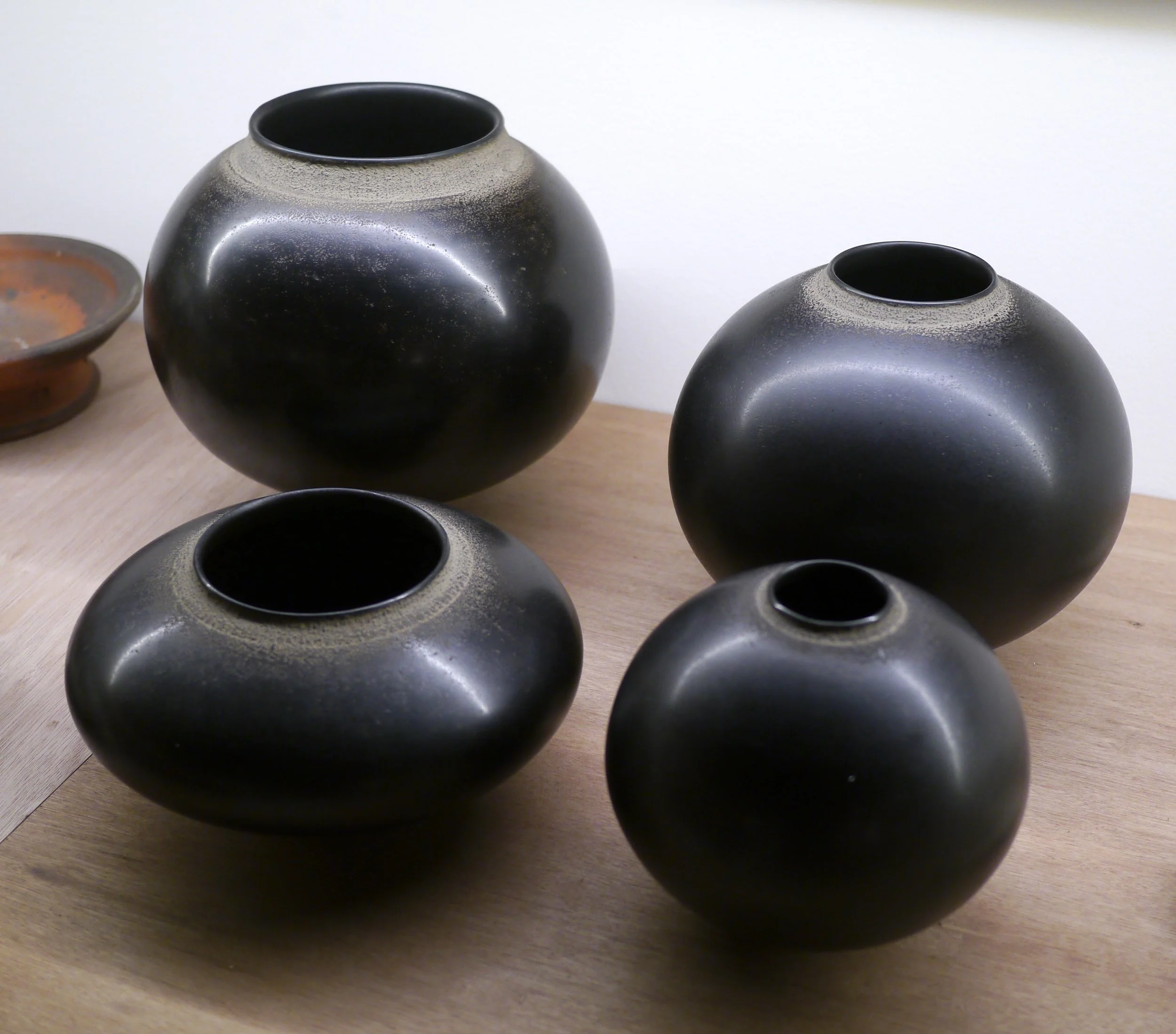
Polished black vessels by Anzai Kenta b. 1980 Fukishima / based in Fukishima
Anzai Kenta originally trained in ceramics as an apprentice to Tatsuzo Shimaoka who was himself a student of Shoji Hamada. Both Tatsuzo Shimoaka and Shoji Hamada were deemed National Living Treasures in Japan, in acknowledgement of their contributions to tangible cultural heritage.
Anzai’s bold approach to material and form honours this historical lineage, utilising earthenware and urushi to create his highly polished black surfaces for which he has now become recognised. His process is labour intensive, with some pieces taking several weeks to complete.
Shimuzu Shiro
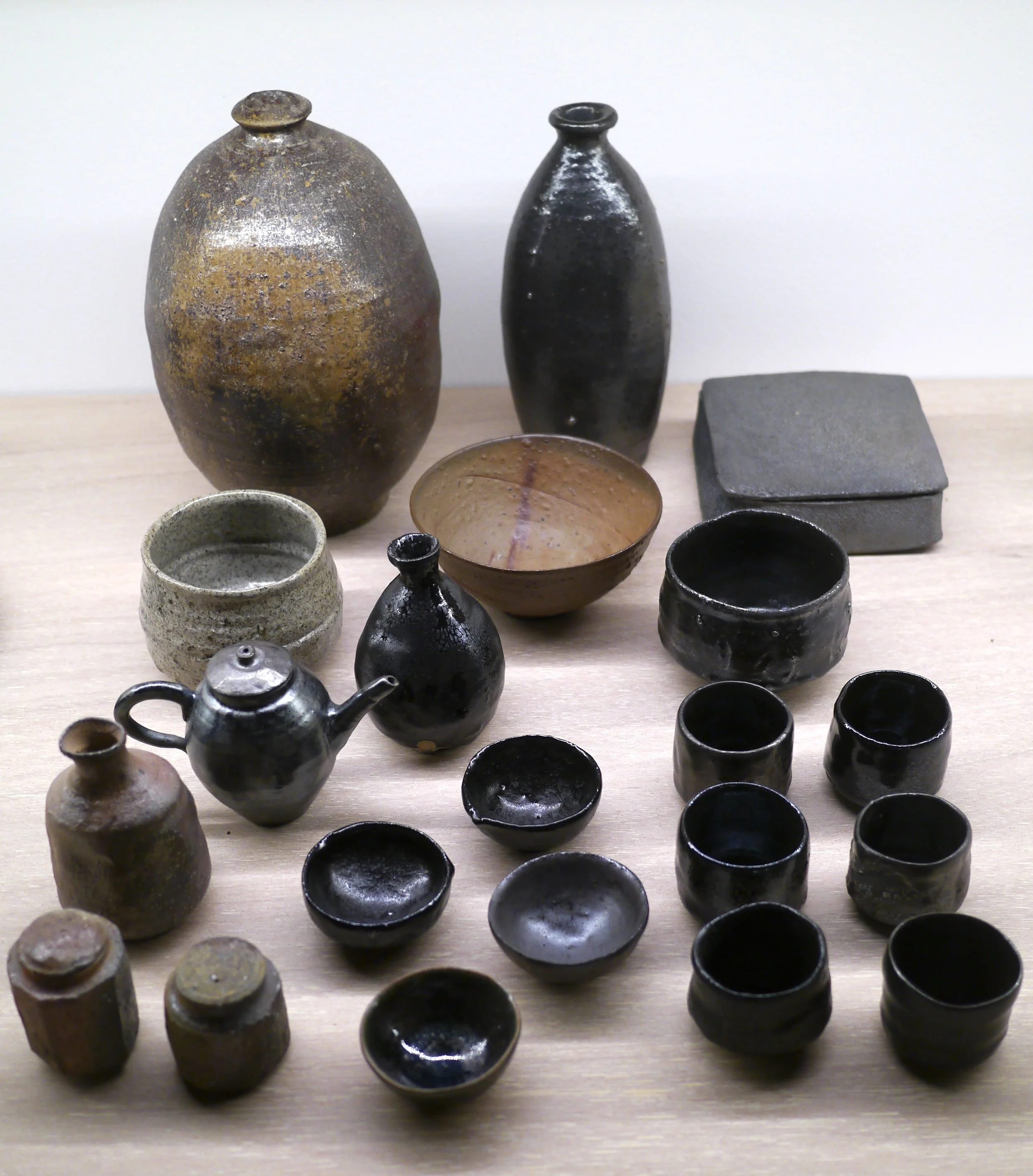
Works on display by Shimuzu Shiro, b.1979 Kyoto / based in Shiga
Shimuzu Shiro (b.1979 Kyoto / based in Shiga) is known for his inventive approach to making, turning what might be considered normative approaches on their head.
Shimuzu Shiro has produced works previously where he travels Japan seeking out suitable varieties of clay, sometimes building a small kiln directly on site close to the source of the clay, rather than having it transported to his studio in Kyoto, where he and his family run their own studio. He is the grandson of Uichi Shimizu, starting his own charcoal kiln in 2012 and building his own studio at Matsugasaki the following year in Kyoto
Yamada Ryutaro
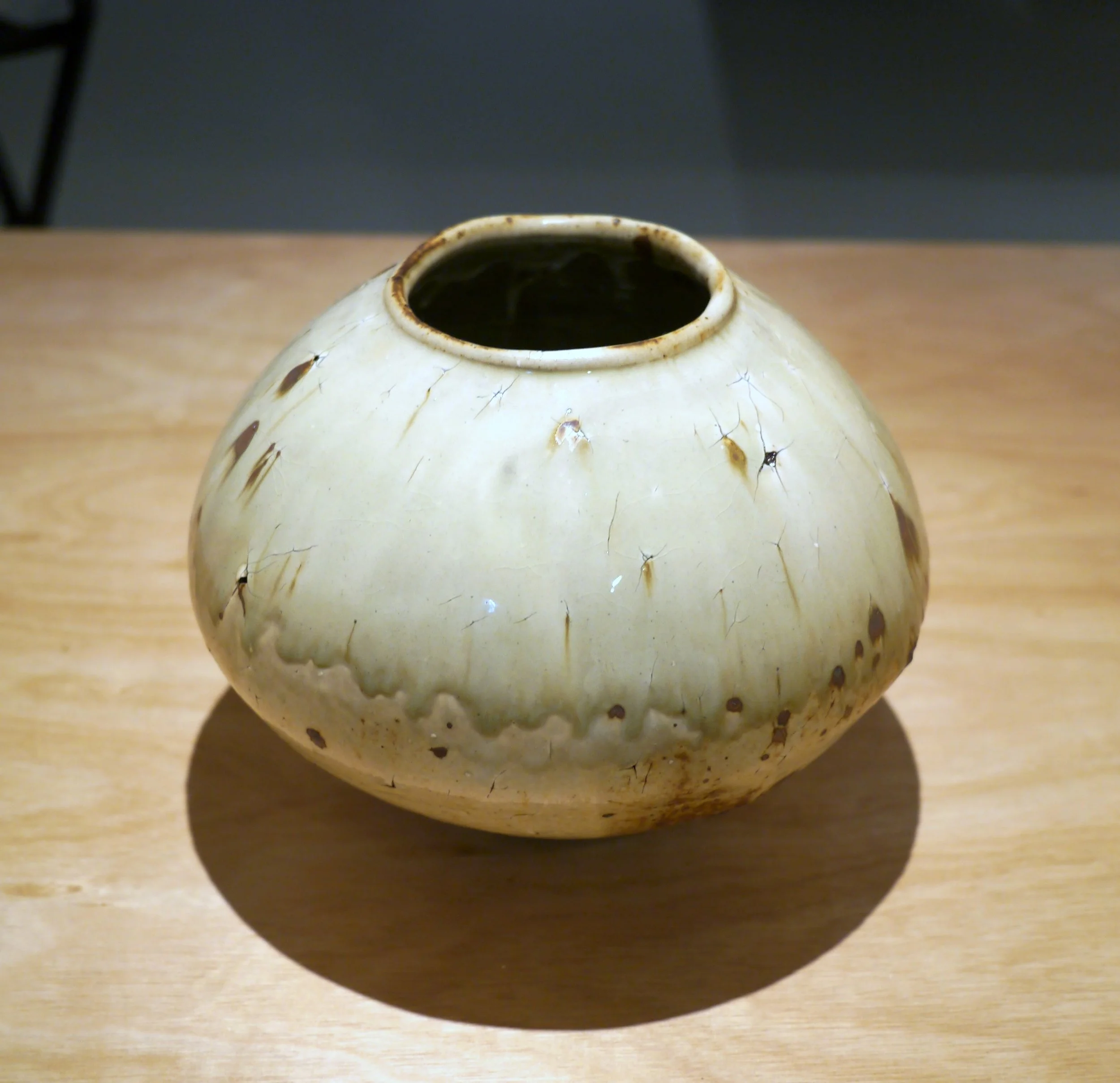
A wood fired piece by Yamada Ryūtarō b. 1984, Saitama / based in Kanagawa
Yamada Ryutaro (b. 1984 Saitama / based in Kanagawa) studied pottery at the Tajimi City Ceramics Design Institute, Gifu Prefecture. He later inherited the kiln and workshop of the late Ryo Aoki. His works are wood fired using traditional kiln technology, which results in the unique wood ash glaze - each piece entirely individual in surface and form. His work is collected by Takashi Murakami and in 2020 he held a solo exhibition at Murakami’s Kaikai Kiki Gallery which displayed over five hundred pieces of his work. He says of his work:
“It has been more than ten years since I began creating ceramics. I began as my wife wanted to attend a ceramics course and casually invited me to come along. It was right around the time when I was diagnosed with a disease, lost all my hair becoming completely bald and almost gave up on life at the age of twenty or so. I guess making ceramics fitted my personality because I became engrossed immediately. I even started to believe that to grind, fire, and sell my ceramics in recluse was the only path I had left. Then, a couple of years ago, I had the opportunity to view the works of the late Ryo Aoki at his residence in former Fujino Town. During my visit, his wife asked if I wanted to use the space because it was vacant. So I decided to move. I carried on like that, supported by coincidental encounters and the meaning of living alone without human contact slowly faded. Lately, whenever I get lonely living in a house in a forest, I go to the convenience store and talk to the lady at the register, then go back to grinding, firing, and selling”. [3]
Morioka Shigeyoshi
Morioka Shigeyoshi (b. 1948 Nara / based in Wakayama) is known for his unglazed, high temperature yakishime stoneware. Raised in Wakayama Prefecture, he began pottery at age 25 after building his own kiln in the mountain village of Amano. His early career included extensive travel to kiln sites across Asia, the Americas, and India, which deeply influenced his approach to natural clay surfaces and wood-firing techniques.
Morioka’s work is celebrated for its deep connection to traditional wood-fired ceramic aesthetics. He has exhibited widely in Japan and abroad, including solo exhibitions in New York, and his pieces are held in major collections such as the Museum of Modern Art (MoMA).
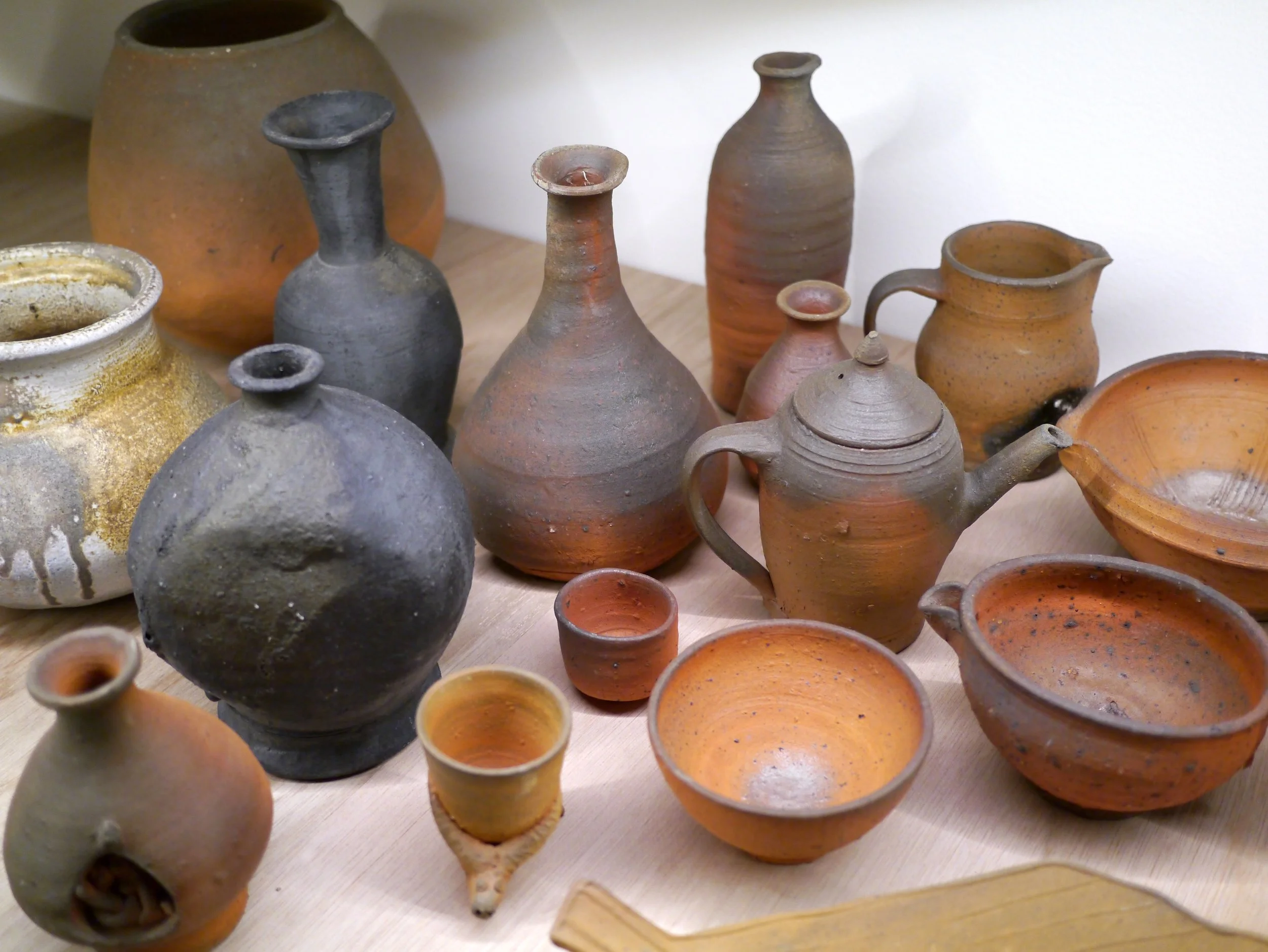
Works by Morioka Shigeyoshi b. 1948 Nara / based in Wakayama
Hyakkō 100+ Makers from Japan is open from 3rd December 2025 - 10th May 2026, at Japan House, Kensington High Street, London.
A link to the exhibition website can be found here.
Notes:
[1] https://www.japanhouselondon.uk/read-and-watch/key-terms-related-to-the-hyakko-100-makers-from-japan-exhibition/ accessed 26/1/2026
[2] ibid
[3] https://en.gallery-kaikaikiki.com/2020/01/ryutaro-yamada-pottery-exhibition-message/ accessed 26/1/2026